
Skilled Nursing Vs Short-Term Rehab: Are They The Same Thing?
Originally published: March 2026 | Reviewed by Sadie Mays

Originally published: March 2026 | Reviewed by Sadie Mays

Skilled nursing is licensed nursing and clinical care delivered inside a Skilled Nursing Facility (SNF). Short-term rehab is a time-limited recovery plan designed to restore safe function after illness, injury, or surgery.
Many short-term rehab stays happen inside SNFs. The right choice depends on medical complexity, measurable therapy goals, and discharge readiness. (cms.gov)
Families in Atlanta can reduce decision stress by following Atlanta placement steps before touring facilities, as a structured comparison helps prevent “nice building bias” from overriding clinical fit.
Families make faster, safer decisions when families separate “care setting” from “care goal.”
A Skilled Nursing Facility is a Medicare and Medicaid-certified facility that provides licensed nursing care and related clinical services.
Medicare’s nursing home comparison framework evaluates SNFs through health inspections, staffing, and quality measures, then summarizes performance with an overall star rating.
Short-term rehab is a recovery goal focused on improving function, safety, and independence after an acute event such as surgery, illness, injury, or severe deconditioning.
Short-term rehab can occur inside a Skilled Nursing Facility or in other post-acute settings, depending on clinical needs and discharge plans.
Long-term skilled nursing describes ongoing care when the resident needs continued safety support, health stability monitoring, or daily assistance, and the discharge plan does not target a rapid return home.
Long-term skilled nursing can include therapy, and therapy in this setting often supports maintenance, safety, and daily function rather than rapid progression.
| Term | What It Means | Primary Goal | What Success Looks Like |
| Skilled Nursing Facility (SNF) | A licensed care setting that provides nursing and clinical services | Deliver safe, monitored care aligned to a plan | Stable condition, risks controlled, measurable goals tracked |
| Short-Term Rehab | A time-limited recovery goal is often delivered in an SNF | Restore function and transition to a less intensive setting | Safer transfers, safer walking, safer daily tasks |
| Long-Term Skilled Nursing | Ongoing care in an SNF with extended support needs | Maintain safety and health stability | Prevent avoidable decline and avoidable crises |
Families who want a plain-language inventory of clinical services can scan nursing services, then use those services as prompts for sharper tour questions.
Sadie G. Mays Health & Rehabilitation Center can help your family label the situation correctly and match goals to services, so the next step feels clear. Schedule a tour.
If you’re ready to get started, call us now!
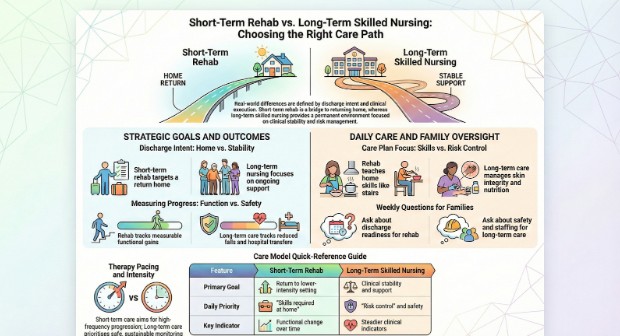
Marketing language blurs categories. Discharge intent and clinical execution reveal the real differences.
Short-term rehab targets discharge to home, assisted living, or another lower-intensity setting. Long-term skilled nursing targets stability and ongoing support. Discharge intent changes therapy pacing, caregiver training urgency, and equipment planning.
Short-term rehab often aims for higher therapy frequency and faster progression, and medical tolerance sets the ceiling. Pain, fatigue, unstable vitals, delirium, and poor sleep can reduce safe therapy intensity even when the diagnosis stays the same.
Skilled nursing becomes the primary need when a resident requires frequent monitoring, complex medication management, wound management, or ongoing clinical oversight. Therapy may still occur, and nursing complexity often drives the safest placement.
Short-term rehab care plans prioritize “skills required at home,” including transfers, toileting routines, stair safety, and medication routines. Long-term skilled nursing care plans prioritize “risk control,” including fall prevention, skin integrity, nutrition stability, and behavioral safety.
Short-term rehab progress should show measurable functional change over time. Long-term skilled nursing progress often shows risk reduction, fewer falls, fewer avoidable hospital transfers, more consistent routines, and steadier clinical indicators.
Short-term rehab questions focus on discharge criteria, readiness milestones, and caregiver training completion. Long-term skilled nursing questions focus on plan updates, safety events, staffing consistency, and risk-control adjustments.
Families who want a concrete early-stay framework can review the first 72 hours, then bring those checkpoints into the first care conference.
A resident often needs skilled nursing care when a resident requires:
Families reduce confusion by naming the primary need out loud. “Safe walking recovery” points toward rehab goals. “Wound management and monitoring” points toward a skilled nursing focus.
Families who want to avoid rushed placements can follow preferred SNF placement requests before hospital discharge, because early requests expand options.
Short-term rehab fits best when the medical status is stable enough to pursue functional gains and when a realistic discharge destination exists.
A resident often fits short-term rehab goals when a resident:
Short-term rehab succeeds when discharge criteria match home reality. Stairs without railings change mobility targets. A caregiver who can only attend evening changes training schedules.
When time pressure rises mid-stay, Sadie G. Mays Health & Rehabilitation Center can review discharge criteria, therapy targets, and weekly updates to help your family stop guessing. Contact us.
If you’re ready to get started, call us now!
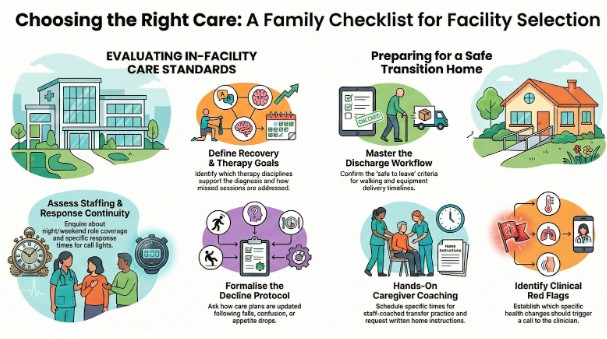
Online reviews can signal experience. Medicare domains standardize comparisons across facilities.
Medicare’s Five-Star Quality Rating System summarizes nursing home performance using separate domain ratings for health inspections, staffing, and quality measures, plus an overall rating.
The health inspections domain reflects results from state health inspections and complaint investigations, which often reveal system issues in areas such as infection control, medication management, and resident rights.
The staffing domain reflects staffing levels reported and used in Medicare’s rating system. Staffing levels influence response times, toileting support, repositioning consistency, and the reliability of supervision.
The quality measures domain reflects specific measures reported to Medicare, including measures for short-stay and long-stay residents. (Medicare)
The overall rating combines the domains into a single comparison signal, and Medicare positions the rating as a starting point for questions rather than a substitute for a visit.
One-Minute Action Box
Compare three facilities using the same domains.
Families who want to verify beyond stars can follow this license and inspection verification guide to connect state inspection history with federal Care Compare data.
A facility tour should produce measurable answers tied to staffing execution and discharge readiness.
Insurance timelines can create pressure. Families who want to reduce discharge delays can understand the process behind Medicare Advantage prior authorization before the deadline appears.
These red flags often appear when a facility uses “rehab” as a label without aligning services with measurable goals.
A coverage-ending notice can create a short decision window. Families can prepare by understanding the NOMNC appeal timeline before the last day.
If your family needs a calm path forward, choose Sadie G. Mays Health & Rehabilitation Center for structured planning and clear communication. Schedule an appointment.
Skilled nursing is licensed nursing and clinical care delivered in a Skilled Nursing Facility. Rehab is a recovery plan focused on restoring function and safety. Many rehab stays happen inside SNFs, but skilled nursing can also be long-term when monitoring and daily support remain the primary need.
Short-term rehab can occur in a nursing home if the facility is Medicare-certified as a Skilled Nursing Facility and provides therapy and nursing services. Short-term rehab describes the goal and expected timeline. A Skilled Nursing Facility describes the licensed care setting where the plan is delivered.
A Skilled Nursing Facility is a Medicare- and Medicaid-certified facility that provides licensed nursing care and related clinical services. Medicare compares SNFs based on health inspections, staffing, and quality measures, then summarizes these domains into an overall star rating for consumers.
An SNF is a licensed setting that can provide nursing care and rehabilitation services. A rehab center often refers to a setting focused primarily on therapy intensity. The practical difference is goal alignment. Rehab-focused plans target measurable function gains for discharge, while skilled nursing-focused plans prioritize monitoring and risk control.
Long-term skilled nursing care is ongoing care in a Skilled Nursing Facility when a resident needs continued support for safety, health stability, or daily care needs. Long-term care plans prioritize fall prevention, skin integrity, nutrition stability, medication routines, and consistent monitoring to prevent avoidable crises.
A resident can start with short-term rehab goals and transition to long-term skilled nursing when discharge becomes unrealistic due to medical complexity, safety risk, or limited caregiving support at home. A safe transition requires a care plan change that updates goals, timeframes, and risk controls to match the new discharge intent.
A parent often needs skilled nursing when clinical monitoring, complex medications, wound management, or high safety supervision is the primary need. A parent often fits short-term rehab when the medical condition is stable enough to pursue functional goals like safer transfers and safer walking with discharge readiness as the target.
Discharge planning in short-term rehab defines functional discharge criteria, schedules caregiver training, confirms equipment needs, and outlines the first-week routine at home. Strong discharge planning starts early because it prevents last-minute surprises and reduces avoidable readmissions.
Medicare domain ratings provide standardized signals beyond reviews. Compare health inspections, staffing, and quality measures across at least three facilities, then confirm fit by asking for measurable discharge criteria and asking how the facility addresses its lowest domain rating.
Medicare star ratings summarize performance across health inspections, staffing, and quality measures, with an overall rating that combines those domains into a single comparison signal. Medicare positions the star rating as a starting point for questions, not as a substitute for in-person visits and evaluation of fit.
Amenities reflect budget and design. Outcomes often reflect staffing execution, inspection performance, and measurable care processes. Medicare domain ratings reveal these operational differences through health inspections, staffing, and quality measures, even when two buildings look equally modern.
Ask which roles cover nights and weekends, how call lights and toileting support are handled, and how turnover affects continuity. Ask who updates the care plan after falls, confusion changes, or appetite decline. Staffing clarity protects safety because it determines response time and the reliability of supervision.