
Long-Term Care Facilities in Atlanta: Types, Costs & How to Choose
Originally published: March 2026 | Updated: September 2026 | Reviewed by Sadie Mays

Originally published: March 2026 | Updated: September 2026 | Reviewed by Sadie Mays

Data last verified: March 2026
When a parent, spouse, or aging relative can no longer manage daily life safely on their own, Atlanta families face one of the most difficult decisions they will ever make. Long-term care is not a single service or a single setting.
It is a spectrum of care options designed to support people who need ongoing medical supervision, help with daily activities, or both. The right answer depends entirely on what that person needs today and what they are likely to need over the months and years ahead.
Atlanta families considering long-term care typically evaluate four primary options: skilled nursing facilities (commonly called nursing homes), assisted living communities, memory care units, and home care services.
Each option serves a different clinical profile and comes with a different cost structure.
If you are just beginning this search, the step-by-step guide to finding long-term care in Atlanta on this site walks you through assessing needs, touring facilities, and making a final decision.
A long-term care facility is any licensed setting that provides ongoing support services to individuals who can no longer live independently. Unlike a hospital, which treats acute illness and discharges patients, a long-term care facility is designed for sustained residence, often for months, years, or permanently.
The defining features of long-term care are its duration and scope. A resident is not recovering from a single event and returning to independent life. They require continuous support across one or more of the following domains:
Georgia licenses and regulates these facilities through the Georgia Department of Community Health (DCH), specifically through its Healthcare Facility Regulation (HFRD) division. Families can
verify a facility’s license and inspection history using HFRD records combined with the federal CMS Care Compare database. Both are free, publicly accessible, and essential starting points for any serious family search.
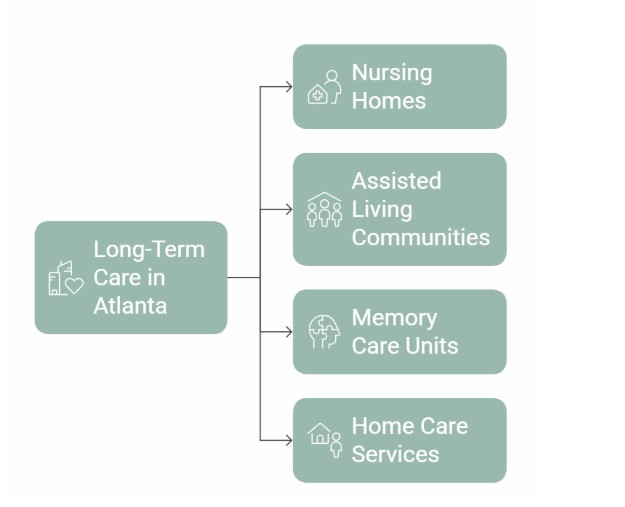
Atlanta’s long-term care landscape covers four distinct models. Understanding the clinical function of each prevents families from placing a loved one in a setting that cannot actually meet their needs.
A skilled nursing facility (SNF) is a Medicare- and Medicaid-certified residential care setting that provides licensed nursing care around the clock.
SNFs serve two populations: residents who need short-term rehabilitation after a hospital stay and residents who require long-term custodial nursing care due to chronic illness, disability, or advanced age.
SNFs are the highest-intensity option in the long-term care continuum. They employ registered nurses, licensed practical nurses, and certified nursing assistants on every shift.
Physician oversight is required, and many residents receive daily therapy services in the facility’s own rehabilitation gym.
Sadie G. Mays Health & Rehabilitation Center provides skilled nursing care to Atlanta residents requiring both short-term rehab and long-term residential nursing support.
The rehabilitative services program includes physical, occupational, and speech therapy delivered by licensed therapists in a dedicated rehab suite.
Assisted living is designed for seniors who are mostly independent but need support with some activities of daily living, such as bathing, dressing, grooming, or medication reminders. Residents typically live in private or semi-private apartments and eat in communal dining rooms. Staff is on-site, but nurse coverage is less intensive than in an SNF.
Assisted living communities vary widely in the services they include in base pricing. Some bundle everything; others charge à la carte for care tiers. Families should review what is and is not included in the monthly rate before signing any agreement.
Memory care is a specialized residential environment designed for individuals living with Alzheimer’s disease, vascular dementia, Lewy body dementia, or other forms of cognitive decline. These units operate within either assisted living buildings or skilled nursing facilities and are physically designed to prevent wandering while promoting dignity and engagement.
Memory care staff receive additional training in dementia communication, behavioral redirection, and person-centered programming. The staff-to-resident ratio is typically higher than in standard assisted living, which is reflected in the cost.
Understanding the progression of a loved one’s condition helps families know when to consider memory care.
The Stages of Alzheimer’s Disease: What to Expect and How to Prepare article on this site outlines what each stage typically looks like and what care level it requires. Families looking for practical daily strategies should also read Dementia Care Strategies: How to Communicate Better and Create Meaningful Connections.
Home care delivers assistance directly to a person’s residence. It exists on two distinct tracks: home health care (skilled clinical services such as wound care, IV therapy, or physical therapy ordered by a physician) and personal care/home aide services (non-medical assistance with bathing, meals, transportation, and housekeeping).
Home care is often the first option families explore when they want to support a loved one without relocating them to a facility.
It works well for individuals who need limited assistance with clear medical or functional needs. When care needs increase beyond what can be safely managed at home, transitioning to a residential setting becomes the more appropriate choice.
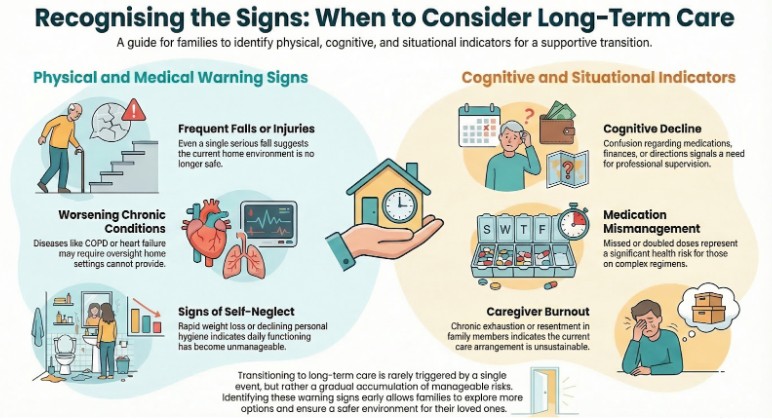
There is no single defining moment when long-term care becomes necessary. Most families describe a gradual accumulation of warning signs that individually seem manageable but together paint a clear picture of risk. Recognizing those signs early expands the options available to the family.
The following situations commonly prompt Atlanta families to begin a serious evaluation of long-term care options:
The article “5 Signs It’s Time to Consider Long-Term Care for Your Loved One in Atlanta” expands on these warning signs with practical guidance on how to bring up the conversation with a parent or spouse in a way that preserves their dignity.
For families navigating the emotional side of this conversation, How to Talk to a Parent About Moving into Long-Term Care offers an Atlanta-specific perspective grounded in both clinical insight and family experience.
Cost is consistently one of the first questions Atlanta families ask — and one of the hardest to answer precisely, because long-term care costs vary significantly based on the type of care, the level of clinical complexity, the room type, and the specific facility.
The table below provides general monthly cost ranges for the Atlanta metro area for planning purposes.
| Care Type | Avg. Monthly Cost (ATL) | Typical Resident | Medicare Eligible? |
|---|---|---|---|
| Skilled Nursing Facility | $8,500 – $11,000 | Complex medical needs, post-hospital rehab | Yes (Part A, limited days) |
| Assisted Living | $3,500 – $6,000 | Needs help with daily tasks, mostly independent | No (private pay / Medicaid waiver) |
| Memory Care | $4,500 – $7,500 | Moderate to advanced dementia or Alzheimer’s | Partial (SNF portion only) |
| Home Care | $3,000 – $6,500 | Prefers independence; mild care needs | Yes (skilled home health only) |
Source: Genworth Cost of Care Survey and Atlanta regional market data. Ranges reflect private-pay rates.
Medicaid-eligible residents may qualify for different rates through the Georgia Medicaid program, administered by the Georgia Department of Community Health.
Several factors push costs toward the higher end of these ranges:
Medicare Part A covers short-term skilled nursing care following a qualifying hospital stay of at least three days. It does not cover custodial long-term care.
The Medicare Coverage for Rehabilitation: Atlanta Family Guide explains exactly what Medicare pays, for how long, and what families are responsible for once those benefits are exhausted.
For a complete overview of insurance, Medicaid waiver programs, and private pay options, see Insurance and Payment Options for Rehabilitation Services in the Greater Atlanta Area.
Visiting a facility once and liking how it looks is not a sufficient evaluation. Families who make confident decisions do so because they applied a consistent standard across every facility they visited. Use the checklist below on every tour.
The Nursing Home Quality Indicators in Georgia: Sadie G. Mays Guide expands on what each quality measure means and how to interpret it when comparing facilities.
For families concerned specifically about infection control standards, Infection Control in Long-Term Care Facilities: Standards Families Should Ask About provides a specific list of questions to raise during any facility tour.
The Centers for Medicare & Medicaid Services (CMS) publishes star ratings for every Medicare- and Medicaid-certified nursing home in the United States through the Care Compare tool.
Each facility receives an overall star rating from one to five stars based on three equally weighted domains.
A five-star overall rating is meaningful, but families should look beyond the composite score. A facility with a five-star overall rating but a two-star staffing rating has a specific quality problem worth investigating. Georgia families can also cross-reference Special Focus Facility (SFF) Program data to identify any facilities that federal oversight has flagged as chronically underperforming.
The federal Georgia HFRD inspection database shows detailed deficiency citations from every state survey. Families can read the actual survey findings, not just the star score, to understand the nature of any cited problems.
Families who approach this decision with a structured process consistently report less anxiety and fewer regrets.
The “How to Find Long-Term Care in Atlanta, GA: Step-by-Step Guide for Families” on this site covers the full decision-making process in sequence, from initial needs assessment through the final placement decision.
The process typically moves through these stages:
Veterans’ families have a separate pathway. Veterans Benefits for Nursing Home Care in Georgia outlines VA coverage, Aid & Attendance eligibility, and Community Care options available to Georgia veterans and surviving spouses.
Atlanta families navigating long-term care decisions have access to several no-cost resources that can help with both clinical guidance and financial navigation.
Choosing a long-term care facility for a parent, spouse, or loved one is a decision that deserves time, information, and a clear-eyed understanding of the options.
Atlanta families have access to strong care communities and well-funded public resources. The challenge is not the absence of good options — it is knowing how to identify them, evaluate them systematically, and match them to a specific person’s clinical and personal needs.
Sadie G. Mays Health & Rehabilitation Center has served Atlanta families since 1948. The facility provides skilled nursing care, rehabilitative services, long-term care, hospice care, and respite care from its campus in Atlanta’s historic Vine City neighborhood.
Families are encouraged to contact the admissions team to schedule a personal tour, ask questions, and learn how Sadie G. Mays can meet their loved one’s specific needs. The admissions team can typically schedule an initial consultation within 24 to 48 hours and is available to help families at every stage of the decision process.
What is the difference between a nursing home and assisted living in Atlanta?
A nursing home provides 24-hour licensed nursing care for medically complex residents. Assisted living supports daily activities like bathing and dressing, but lacks on-shift nurses and cannot manage complex medical conditions.
Does Medicare pay for long-term care in Atlanta nursing homes? Medicare Part A covers only short-term skilled nursing rehab, not custodial long-term care. It pays fully for days 1–20 after a qualifying hospital stay. Medicaid, long-term care insurance, and private pay fund ongoing custodial placement.
How do I know when it is time to move a parent into long-term care?
Time to consider long-term care when frequent falls, worsening chronic conditions, medication mismanagement, or caregiver burnout signal that current arrangements are unsafe. A physician or geriatric care manager can conduct a formal needs assessment.
What should I look for when touring a nursing home in Atlanta?
When touring, check staffing ratios, observe staff-resident interactions, and review CMS Care Compare inspection scores beforehand. Ask about turnover rates and how the facility communicates with families when a resident’s condition changes.
What financial assistance is available for long-term care in Georgia?
Georgia Medicaid covers skilled nursing care for eligible residents. Veterans may qualify for VA benefits or Aid & Attendance. The Atlanta Regional Commission Area Agency on Aging connects families with free benefits counselors for Medicaid and veterans programs.