
When a Resident’s Needs Change: How a Skilled Nursing Facility Decides Whether the Care Plan Needs to Change
Originally published: August 2026 | Reviewed by Sadie Mays

Originally published: August 2026 | Reviewed by Sadie Mays
A skilled nursing facility must reassess a resident within 14 days of determining that a significant change in condition has occurred, then revise the written care plan within 7 more days after that assessment is complete.
Sadie G. Mays Health & Rehabilitation Center is a 206-bed, 501(c)(3) nonprofit skilled nursing facility in northwest Atlanta, founded in 1947, and its interdisciplinary team follows this federal framework for care plan reviews whenever a resident’s needs shift.
Outside of a significant change, federal regulation also requires the interdisciplinary team to review and revise the care plan after every quarterly assessment, at least once every 90 days.
Noticing changes in a parent’s condition and not knowing what happens next is stressful — the Sadie G. Mays admissions team explains how reviews work.
A care plan review can be triggered in two ways: a scheduled reassessment, or a significant change in the resident’s condition that can’t wait for the schedule.
Federal regulation defines a significant change as a major decline or improvement in a resident’s status that will not normally resolve itself without further intervention by staff or standard clinical interventions, has an impact on more than one area of the resident’s health status, and requires interdisciplinary review or revision of the care plan, or both.
Whether a specific event qualifies depends on the resident’s overall clinical picture, not the diagnosis alone — a urinary tract infection that resolves within a week or two is generally treated as self-limiting, while a stroke, a hip fracture, or a sustained pattern of weight loss is more likely to meet the criteria, though the interdisciplinary team makes that determination case by case.
Families going through discharge planning or watching a resident recover from restorative nursing should know that either kind of change can prompt a full reassessment, not just a note in the chart.
If you’re ready to get started, call us now!
The interdisciplinary team (IDT) decides whether a change is significant enough to require a full reassessment, not a single nurse or aide acting alone. Federal regulation requires the comprehensive care plan to be prepared by an interdisciplinary team with defined membership:
| IDT Member | Role in Care Plan Review |
| Attending physician | Confirms medical significance of the change |
| Registered nurse | Coordinates the assessment and documents clinical status |
| Nurse aide | Provides day-to-day observation of the resident |
| Food and nutrition staff | Assesses dietary and nutritional impact |
| Resident and resident representative | Participates to the extent practicable |
Facilities commonly loop in the resident’s physician and the medical director when needed to help judge whether a change looks temporary or lasting — that’s common practice rather than a fixed federal step, so families should ask their specific facility how disagreements among the team get resolved.
The resident and resident representative should be part of this team, not informed only after a decision is made.
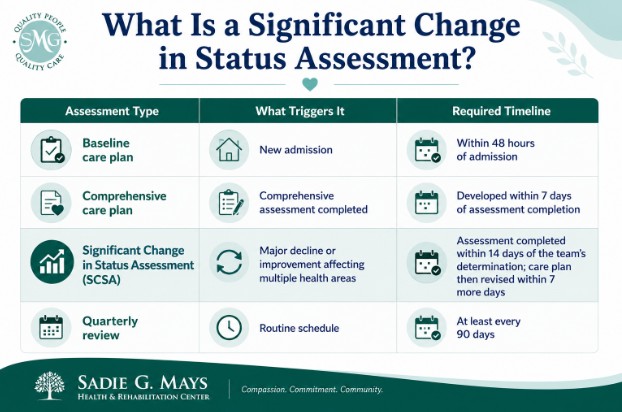
A Significant Change in Status Assessment (SCSA) is the comprehensive reassessment a facility must complete once the interdisciplinary team determines a qualifying change has occurred.
Facilities must complete the SCSA—including every triggered Care Area Assessment and the structured clinical reviews covering areas like falls, pain, and nutrition—within 14 calendar days of that determination, under the timing rules in CMS’s current RAI Manual (version 1.20.1, effective October 1, 2025).
Completing the assessment is not the final step: federal regulation separately requires the comprehensive care plan to be developed within 7 days after the comprehensive assessment is completed.
Read together, that generally means a resident’s care plan should be fully updated within roughly three weeks of the team first determining a significant change occurred.
That combined figure is a reader-facing summary, not a separate regulatory deadline; the two 42 CFR requirements it’s built from—one governing assessment completion, one governing care-plan development—should be confirmed against Sadie G. Mays’ own compliance process before treating this figure as facility policy.
| Assessment Type | What Triggers It | Required Timeline |
| Baseline care plan | New admission | Within 48 hours of admission |
| Comprehensive care plan | Comprehensive assessment completed | Developed within 7 days of assessment completion |
| Significant Change in Status Assessment (SCSA) | Major decline or improvement affecting multiple health areas | Assessment completed within 14 days of the team’s determination; care plan then revised within 7 more days |
| Quarterly review | Routine schedule | At least every 90 days |
Federal regulation requires a facility to review every resident’s care plan on a routine schedule, independent of whether a significant change has occurred. A facility must assess a resident using the quarterly review instrument at least once every 3 months.
The interdisciplinary team must then review and revise the comprehensive care plan after each assessment, including both the comprehensive and quarterly review assessments.
A quarterly review is a shorter instrument than a full comprehensive or significant-change assessment, but it still triggers an IDT review of the care plan — which is how the routine schedule catches slower, cumulative changes that don’t meet the significant-change threshold on any single day but add up over a quarter, such as a gradual decline in appetite or a slow loss of mobility.
Once the interdisciplinary team completes a reassessment, the facility updates the written care plan and adjusts the services a resident receives — nursing routines, therapy referrals, dietary needs, or level of supervision.
The comprehensive care plan must describe the services to be furnished to attain or maintain the resident’s highest practicable physical, mental, and psychosocial well-being.
Staff assignments and daily routines change to match the updated plan, and the revision becomes the new baseline for the next quarterly review.
A resident coming off restorative nursing, for example, might see their care plan revised to add a new goal, extend an existing one, or refer the resident back to formal therapy.
Understanding when and why a care plan changes shouldn’t require a law degree — the Sadie G. Mays admissions team helps explain what a revision means.
If you’re ready to get started, call us now!
The resident — or, when the resident can’t participate directly, their resident representative — has a defined legal role in the care plan process, not just a courtesy update after decisions are made.
Federal regulation gives the resident the right to participate in the planning process, including the right to request meetings and the right to request revisions to the person-centered plan of care, the right to help establish the expected goals and outcomes of care, the right to be informed in advance of changes to the plan, and the right to see the care plan, including the right to sign after significant changes.
“Resident representative” is a specific legal designation — often a family member with healthcare decision-making authority, but not automatically every relative — so families should confirm who is formally recognized as the resident’s representative at admission.
In practice, facilities generally involve engaged family members beyond the letter of the regulation, and a family member can request a care plan meeting or ask questions about a proposed change.
Georgia’s Long-Term Care Ombudsman Program is a state resource families can contact if they feel this process isn’t being followed.
Families often notice a change before staff documents it, especially during visits spaced further apart than daily care.
A family member who sees new confusion, a sudden reluctance to walk, or a noticeable drop in appetite should raise it directly with the nursing staff and ask whether it meets the threshold for a significant change review.
Documenting what was observed and when — rather than describing it only as “seems different” — gives the interdisciplinary team a concrete starting point.
Families weighing long-term care options or comparing skilled nursing to assisted living can use the same question — what changed, who evaluates it, and what happens next — as a framework for any facility they’re considering.
What triggers a care plan review at a skilled nursing facility? A care plan review happens on a routine quarterly schedule, or whenever a resident has a significant change — a major decline or improvement affecting more than one health area. Either trigger requires the team to reassess and update the plan.
Who decides whether a resident’s care plan needs to change? The interdisciplinary team decides — not one nurse or aide acting alone. Federal regulation requires the team to include the attending physician, a registered nurse, a nurse aide, food and nutrition staff, and, when practicable, the resident and their representative.
What is a Significant Change in Status Assessment? A Significant Change in Status Assessment (SCSA) is a comprehensive reassessment required when a resident has a major decline or improvement affecting multiple health areas. Facilities must complete it within 14 days of that determination, then revise the care plan within 7 more days.
How often is a care plan reviewed if nothing major happens? Federal regulation requires the interdisciplinary team to review and revise the care plan after every quarterly assessment, completed at least once every 90 days. This routine review catches slower changes — like gradual weight loss or declining mobility — that build up over time without meeting the significant-change threshold.
How quickly must a facility act after identifying a significant change? Federal regulation gives facilities 14 calendar days from the point the team determines a significant change occurred to complete a full reassessment. The interdisciplinary team must then revise the resident’s care plan within 7 more days — about 21 days total.
Can a family request a care plan review? Yes. Federal regulation gives the resident, or their resident representative, the right to request meetings and care plan revisions, not just wait for the facility’s routine schedule. Raising a specific, observed change with the nursing staff is the most direct way to prompt a reassessment.
Does the resident get to see the revised care plan? Yes. Federal regulation gives the resident and their representative the right to see the care plan and to be informed in advance of changes to it. That right belongs to the resident and their representative specifically, so families should confirm their own standing before assuming automatic access.
What’s the difference between a quarterly review and a significant change assessment? A quarterly review is a shorter, routine assessment completed every 90 days that doesn’t reset the full comprehensive record. A Significant Change in Status Assessment is a full reassessment triggered by a major decline or improvement, required within 14 days regardless of the regular schedule.
What happens if a facility misses a required care plan review? A missed significant-change assessment can lead to a regulatory finding during a state survey, since federal rules require it. More practically, it means the resident’s documented care plan may not reflect their actual needs, which is why families should ask if they notice a gap.
Who is on the interdisciplinary team that revises the care plan? Federal regulation requires the team to include the resident’s attending physician, a registered nurse, a nurse aide familiar with the resident, and a member of food and nutrition services staff. The resident and their representative participate to the extent practicable.
A care plan changes on two tracks: a routine review tied to every quarterly assessment, at least every 90 days, or a faster path — assessment within 14 days, then a revised plan within 7 more days — whenever a resident has a significant decline or improvement.
The interdisciplinary team, made up of the physician, nurse, aide, dietary staff, and the resident or their resident representative, makes that determination together, and the resident has the right to be part of the conversation and see the plan before and after it changes.
A parent’s care plan shouldn’t change without the family understanding why — the Sadie G. Mays admissions team helps explain what changed. Call 678-420-2946.