
Helping vs. Doing For:
How Families Can Preserve a Nursing Home Resident’s Independence
Originally published: November 2026 | Reviewed by Sadie Mays

Originally published: November 2026 | Reviewed by Sadie Mays
Doing for a nursing home resident means completing a task the resident could still do with time, cues, or support, while helping means giving only the assistance the resident needs to do it.
Federal rule 42 CFR 483.24(a) requires a certified facility, consistent with each resident’s needs and choices, to keep daily living abilities from declining unless the resident’s clinical condition makes decline unavoidable.
Sadie G. Mays Health & Rehabilitation Center, a skilled nursing facility in Atlanta, Georgia, works toward that goal through in-house rehabilitative services and restorative nursing.
Helping and doing for differ in who finishes the task. Helping leaves the resident in charge of as much of the task as safely possible, while doing for hands the whole task to someone else.
The four levels below are a plain-language way for families to think about assistance in skilled nursing, not clinical categories from a care plan.
| Approach | What It Looks Like | When It Fits | Trade-Off |
| Encouraging | Verbal cues and the therapist’s exact wording, with no hands-on help | The resident can do the task but starts slowly or forgets steps | Takes patience and time at each visit |
| Supporting | Setting up the task, such as laying out clothes, without doing any part of it | The care plan targets the task as a goal | Family must know which steps the resident is practicing |
| Helping | Doing one hard step, such as buttons, while the resident does the rest | The resident can finish most of the task | Easy to slide into taking over the whole task |
| Doing for | Completing the whole task | The care plan calls for full assistance, or safety requires staff | Faster, but the resident gets no practice |
The right level depends on the resident’s own wishes and care plan, not on how much time a visit allows. The care plan records which daily tasks the team is working on and how much help the resident needs with each.
Doing too much matters because daily tasks are also daily practice, and federal rules treat preventable loss of function as something to avoid. Under 42 CFR 483.24(a)(1), a facility must provide treatment and services to maintain or improve a resident’s ability to carry out daily living tasks.
Researchers have described the risk in other care settings. A 2015 assisted living study in The Gerontologist by Elizabeth Galik and colleagues described task-based care as a “just get it done” approach.
In that approach, residents are not encouraged to comb their hair, brush their teeth, or walk, and the authors linked the pattern to functional decline.
That study covered assisted living, not nursing homes, and its own trial found no significant difference in daily function between groups over six months. Sadie G. Mays physical therapy works on walking and balance, two of the abilities at stake.
Nursing home data on restorative care shows a similar uncertainty. A separate 2015 restorative care analysis in The Gerontologist by Kristine Talley and colleagues used 2003 to 2006 Minimum Data Set (MDS) records for 7,735 long-stay residents.
Over 18 months, activities of daily living (ADL) dependency rose 0.5 points for restorative program participants and 1.0 point for nonparticipants. The authors did not find that difference statistically significant.
For families, the practical reading is modest. The research does not prove that encouraging self-care prevents decline, but federal rules still require facilities to preserve function where possible.
If you’re ready to get started, call us now!
Families should leave tasks with a fall or swallowing risk to staff unless the care team has cleared the family to help that specific resident.
The Sadie G. Mays therapy guidance for families advises against three things: unsupervised transfers, hallway walking without staff clearance, and equipment changes without therapist confirmation.
| Task | Family Can Help By | Leave to Staff When |
| Transfers (bed to chair, chair to standing) | Bringing the right footwear and encouraging the resident | Staff have not cleared the family, since Sadie G. Mays guidance rules out unsupervised transfers |
| Walking in hallways | Walking alongside after staff clearance | The resident has not been cleared for hallway walking |
| Walker, wheelchair, or brace changes | Reporting fit problems to the therapist | Any adjustment, which needs therapist confirmation |
| Dressing and grooming | Allowing time and using the therapist’s cue words | The care plan calls for staff assistance |
| Eating with swallowing problems | Using safe feeding methods taught by speech therapy | No family training has taken place |
Clearance applies to one resident at one point in time. Families should recheck after a fall, illness, hospital stay, or care plan change, because the right level of help can shift with the resident’s condition.
Sadie G. Mays, a speech therapists teach family members safe feeding techniques for residents with swallowing problems.
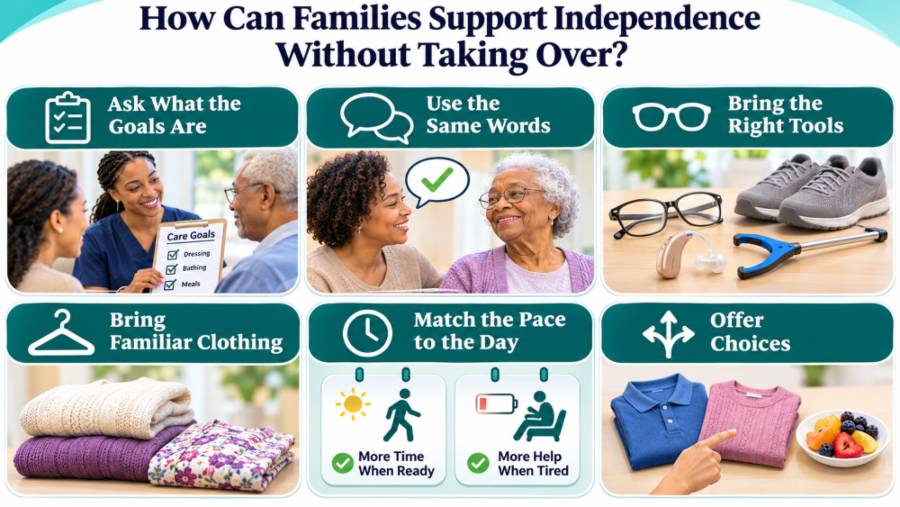
Families support independence by following the resident’s wishes and care plan and letting the resident do every step the plan targets.
At Sadie G. Mays, occupational therapists show residents how to manage dressing, bathing, and meals with less help. Restorative nursing continues that daily practice after formal therapy ends. Several habits keep a visit supportive:
Restorative-trained nursing assistants carry this kind of practice into each resident’s day.
Residents who finish formal therapy can keep practicing mobility, dressing, and eating every day through a nursing-led program called restorative nursing. An RN designs and periodically evaluates each program.
The resident’s own choice comes first, and disagreements about help belong in a care plan meeting. Under 42 CFR 483.10(c)(2), the resident has the right to name who takes part in care planning, request meetings and revisions, and help decide the type and amount of care.
A family member may speak for the resident only within the authority the resident delegated or that a court granted under 42 CFR 483.10(b).
Federal rules also set the limits of that conversation. Under 42 CFR 483.10(e)(3), residents receive services with reasonable accommodation of their needs and preferences.
An exception applies when an accommodation would endanger the resident’s or others’ health or safety. Families preparing for a care plan discussion can bring three questions:
A family that cannot resolve a disagreement with the facility about rehab or long-term care can contact the Georgia Long-Term Care Ombudsman Program. The program investigates and works to resolve complaints from long-term care residents.
Should families help a parent with daily tasks in a nursing home?
Families can help, but the help should match the resident’s wishes and care plan. Federal rule 42 CFR 483.24(a) requires care that, when possible, keeps daily living abilities from declining, so families should ask which tasks the resident is practicing before stepping in.
Is it better to let a parent do everything slowly?
Not always. Extra time helps on good days, but pain and fatigue can limit safe participation. Sadie G. Mays therapy guidance suggests asking the team to adjust schedules around a resident’s best energy windows rather than pushing through a hard day.
Can family members help a resident get out of bed or walk?
Only with staff clearance for that resident. Sadie G. Mays guidance advises families against unsupervised transfers, hallway walking without staff clearance, and equipment changes without therapist confirmation. Clearance can change after a fall, illness, or hospital stay, so families should recheck.
What is restorative nursing?
Restorative nursing is a nursing program that helps residents keep the function they regained in therapy. At Sadie G. Mays, nursing assistants with restorative training lead daily practice in walking, dressing, and eating, under a program a registered nurse designs and periodically evaluates.
Does restorative care prevent decline?
Evidence on that question is mixed. A 2015 study of 7,735 long-stay residents found ADL dependency rose 0.5 points among restorative program participants and 1.0 point among nonparticipants over 18 months, but the authors did not find that difference statistically significant.
Can a family member make care decisions for a nursing home resident?
Only within the authority the resident delegated or a court granted. Under 42 CFR 483.10(b), a representative exercises only the rights the resident delegated, and the resident retains all others. A resident whom a court has judged incompetent still takes part in care planning when practicable.
What can families do if they disagree with staff about assistance?
Families can ask the resident to request a care plan meeting, since 42 CFR 483.10(c)(2) gives the resident that right. If the disagreement continues, the Georgia Long-Term Care Ombudsman Program investigates and works to resolve complaints from long-term care residents.
Can a resident refuse help with daily tasks?
Residents have a federal right under 42 CFR 483.10(f)(2) to make choices about aspects of life that matter to them. The facility accommodates preferences unless doing so would endanger the resident or others, and a care plan meeting is where safety concerns get worked through.
Helping keeps the resident doing as much of a task as safely possible, while doing for takes the task over. To protect a parent’s independence, families can:
Families want a parent to keep doing what they still can. The Sadie G. Mays admissions team explains how therapy supports that. Call 678-420-2946.