
Medicare Coverage for Rehabilitation: Atlanta Family Guide (2026)
Originally published: July 2025 | Updated: September 2026 | Reviewed by Sadie Mays

Originally published: July 2025 | Updated: September 2026 | Reviewed by Sadie Mays

Medicare Part A covers up to 100 days of skilled nursing facility rehabilitation per benefit period, with full coverage for the first 20 days for patients who meet the three-day inpatient hospital stay requirement.
Atlanta families navigating a post-hospital discharge need to understand four variables: the qualifying hospital-stay rule, the coverage-period cost structure, coinsurance amounts, and how Georgia Medicaid coordinates with Medicare when benefits run out.
Medicare covers rehabilitation services in Atlanta through both Part A and Part B, depending on whether the care is delivered in an inpatient or outpatient setting.
Medicare Part A covers inpatient rehabilitation in certified skilled nursing facilities following a qualifying hospital stay. Medicare Part B covers outpatient physical therapy, occupational therapy, and speech therapy delivered in approved outpatient settings.
Three Medicare programs cover rehabilitation in Atlanta. Part A covers inpatient rehabilitation in skilled nursing facilities following a qualifying hospital stay.
Part B covers outpatient physical, occupational, and speech therapy at approved facilities. Part C — Medicare Advantage — covers rehabilitation through private plans that contract with Medicare, with benefits and provider networks that vary by plan.
Two special coverage situations apply outside the standard rules. Patients diagnosed with amyotrophic lateral sclerosis qualify for Medicare benefits with no waiting period and may access rehabilitation services immediately after diagnosis.
Patients who revoke hospice benefits may transition back to curative-intent rehabilitation services covered under Part A, provided they meet the standard eligibility criteria.
Medicare requires three conditions for inpatient rehabilitation coverage: a qualifying three-day inpatient hospital stay, a physician certification that skilled care is medically necessary, and admission to a Medicare-certified skilled nursing facility within 30 days of hospital discharge.
Sadie G. Mays Health & Rehabilitation Center is a fully Medicare-certified facility serving Atlanta families. Contact our admissions team to confirm eligibility before discharge planning begins.
If you’re ready to get started, call us now!

Medicare Part A rehabilitation coverage activates when two conditions are met simultaneously: a qualifying inpatient hospital stay of at least three consecutive days and a written physician order certifying that skilled care is medically necessary. Both conditions must be documented before Medicare will authorize placement in a skilled nursing facility.
Medicare Part A requires a minimum of 3 days of inpatient hospital admission before covering rehabilitation in a skilled nursing facility. The three-day count begins on the date of formal inpatient admission and excludes the day of discharge — a patient admitted Monday and discharged Thursday has met a three-day qualifying stay.
Emergency room visits, regardless of duration, do not count toward this threshold. Observation status — a billing classification used by hospitals that is distinct from formal inpatient admission — does not count either, even when a patient occupies a hospital bed for multiple nights.
Families should confirm inpatient admission status directly with the hospital billing department before assuming the three-day rule has been met.
The NOTICE Act, enacted by Congress, requires hospitals to notify patients in writing within 36 hours of receiving observation care, specifically because observation status disqualifies patients from Medicare-covered skilled nursing facility placement.
Transfer to a certified skilled nursing facility must occur within 30 days of hospital discharge for Part A coverage to apply.
Medicare Part A requires a written physician certification that skilled nursing or rehabilitation services are medically necessary before coverage activates.
Skilled care services covered under this certification include physical therapy, occupational therapy, and speech-language pathology — services that 42 CFR §409.32 defines as requiring the training and clinical judgment of a licensed professional to be performed safely and effectively.
Medicare does not cover custodial care — assistance with bathing, dressing, or other activities of daily living — when skilled care is not concurrently required.
Skilled care must be provided daily or at least five days per week to maintain Medicare coverage. The treating physician must document clinical progress and certify continued medical necessity at regular intervals throughout the patient’s stay.
Medicare auditors review these certifications; facilities that cannot document ongoing skilled care needs will face coverage termination regardless of the patient’s remaining benefit days.
Sadie G. Mays Health & Rehabilitation Center’s rehabilitative services team coordinates physician certification documentation to protect uninterrupted coverage for every admitted patient.
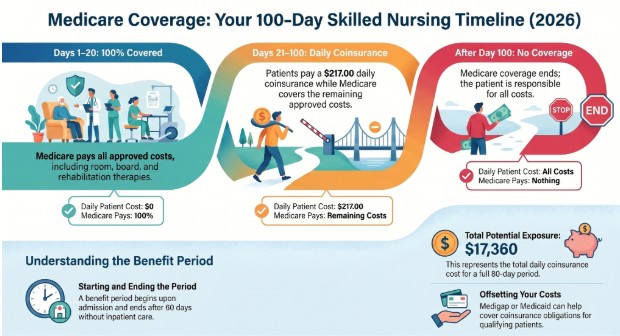
Medicare Part A divides skilled nursing facility coverage into three cost tiers based on length of stay within a single benefit period.
A benefit period begins on the day a patient is admitted to a hospital or skilled nursing facility and ends after 60 consecutive days without inpatient hospital or skilled nursing care.
| Coverage Period | Patient Cost (2026) | Medicare Pays |
| Days 1–20 | $0 | 100% of approved costs |
| Days 21–100 | $217.00 per day | Remaining approved costs |
| After Day 100 | All costs | Nothing |
Medicare covers 100 percent of approved costs for the first 20 days in a certified skilled nursing facility, including room and board, all rehabilitation therapies, nursing services, medications administered at the facility, and medically necessary equipment such as wheelchairs and walkers.
Patients owe nothing out of pocket during this period, provided the facility is Medicare-certified, and the physician certification for skilled care remains active.
Beginning on day 21, patients pay a daily coinsurance of $217.00 in 2026, confirmed by the Centers for Medicare & Medicaid Services’ November 2025 fact sheet. Medicare pays the remaining approved costs beyond that daily amount.
A patient who requires the full 100-day benefit period would pay $217.00 per day for 80 days — a total potential coinsurance exposure of $17,360 — before Medicare coverage ends. Medigap supplemental insurance and Georgia Medicaid can both offset this coinsurance obligation for qualifying patients.
Medicare Part A does not cover skilled nursing facility costs beyond 100 days in a single benefit period. All costs after day 100 become the patient’s full responsibility unless a new benefit period begins.
A new benefit period opens after a patient has gone 60 consecutive days without receiving inpatient hospital or skilled nursing facility care — at which point the full 100-day benefit resets, along with the Part A deductible.
If you’re ready to get started, call us now!
Coinsurance is the portion of covered medical costs that a Medicare beneficiary pays after meeting the applicable deductible.
Rehabilitation coinsurance applies under both Part A and Part B, depending on the care setting, and Part D coinsurance applies to prescription medications administered during recovery.
The Medicare Part A inpatient hospital deductible is $1,736 per benefit period in 2026, covering the first 60 days of a qualifying hospital stay at no additional daily cost. From day 61 through day 90 of a hospital stay, patients pay $434 per day in coinsurance.
For skilled nursing facility stays, the day 21 through 100 coinsurance is $217.00 per day in 2026 — both figures verified against the CMS 2026 Medicare Parts A and B Premiums and Deductibles fact sheet.
The annual Medicare Part B deductible is $283 in 2026. After meeting the deductible, patients pay 20 percent coinsurance for all Part B-covered outpatient services — including outpatient physical therapy, occupational therapy, and speech therapy — while Medicare pays the remaining 80 percent.
Part B coinsurance has no annual out-of-pocket cap under Original Medicare, which makes supplemental Medigap coverage particularly valuable for patients requiring extended outpatient rehabilitation.
Medicare Part D covers prescription medications administered during rehabilitation. The annual out-of-pocket cap for Part D drugs is $2,100 in 2026, confirmed by the CMS Final CY 2026 Part D Redesign Program Instructions.
Once a patient’s out-of-pocket drug spending reaches $2,100, the plan pays 100 percent of covered medication costs for the remainder of the calendar year. The maximum Part D deductible is $615 in 2026.
Medigap policies — Medicare supplement insurance plans sold by private insurers — cover coinsurance gaps that Original Medicare does not pay. For patients in skilled nursing facility rehabilitation, long-term care planning that includes a Medigap policy can eliminate or substantially reduce the $217.00 daily coinsurance obligation for days 21 through 100.
Medigap Plan G and Plan N each cover the skilled nursing facility daily coinsurance in full. Families should compare Medigap options during Medicare open enrollment periods to identify coverage that addresses the specific coinsurance exposure rehabilitation creates.
Georgia Medicaid functions as secondary coverage when Medicare rehabilitation benefits are exhausted or when specific costs fall outside Medicare’s scope.
Families can apply for Georgia Medicaid while a loved one is still receiving Medicare-funded rehabilitation, avoiding coverage gaps when the 100-day benefit period ends.
Medicare Part A covers skilled nursing facility rehabilitation for a maximum of 100 days per benefit period. Georgia Medicaid can cover the following costs that Medicare does not pay: long-term skilled nursing facility stays beyond 100 days, ongoing therapy after Medicare coverage ends, non-emergency medical transportation to and from appointments, and certain durable medical equipment not covered under Part D.
Patients who receive both Medicare and Medicaid — called dual-eligible beneficiaries — have Medicaid paying the Medicare coinsurance in many circumstances, including the $217.00 daily skilled nursing facility coinsurance for days 21 through 100.
Georgia Medicaid applications can be submitted while a patient is actively receiving Medicare-covered care. Starting the application early prevents coverage gaps when Medicare benefits end.
Georgia Pathways to Coverage serves adults ages 19 to 64 who meet income and qualifying activity requirements, with household income eligibility set at up to 100 percent of the Federal Poverty Level — approximately $15,650 annually for one person under current federal poverty guidelines.
Hospital social workers in Atlanta typically assist patients and families with Medicaid paperwork during the inpatient or rehabilitation stay.
Required documents for a Georgia Medicaid application include: Social Security cards for all household members, current income statements or employer verification, bank account information, medical records from the qualifying hospital stay, and proof of Georgia residency. County DFCS offices process Medicaid applications and can advise families on program eligibility based on income, asset levels, and care setting.
For patients transitioning from short-term rehabilitation to long-term nursing home care, different income and asset limits apply — the nursing home Medicaid income limit in Georgia is $2,982 per month in 2026.
Medicare certification must be confirmed before admission to any skilled nursing or rehabilitation facility. A facility that accepts Medicare must maintain active certification with the Centers for Medicare & Medicaid Services — certification that can lapse, be suspended, or be voluntarily relinquished without prominent public notice.
Three verification steps protect families before signing admission documents. First, call the facility’s admissions office and request written confirmation of active participation in Medicare Parts A and B.
Second, search the facility by name on CMS Care Compare at medicare.gov, which displays certification status, inspection history, staffing ratings, and quality measures for every certified facility in the country. Third, request the facility’s Medicare provider enrollment number — a unique identifier that confirms active participation in the Medicare program.
Ask the facility four specific questions before admission: whether the facility accepts Medicare Part A for inpatient skilled nursing coverage, whether Medicare Part B outpatient therapy is available on-site, how the facility processes Medicare claims, what the billing timeline is, and what the patient’s estimated out-of-pocket responsibility will be under the applicable coverage period.
CMS certifies outpatient rehabilitation providers separately from inpatient skilled nursing facilities — a facility may hold one certification but not the other.
Three red flags indicate a facility should not be trusted for Medicare coverage: demanding large upfront cash payments before confirming Medicare coverage, providing evasive or inconsistent answers about Medicare billing procedures, and pressuring families to sign financial responsibility agreements before admission documentation is complete.
Sadie G. Mays Health & Rehabilitation Center is a fully Medicare-certified skilled nursing facility in Atlanta. Families can confirm certification status through CMS Care Compare before contacting admissions.
Sadie G. Mays Health & Rehabilitation Center is a 206-bed Medicare- and Medicaid-certified skilled nursing facility located at 1821 Anderson Avenue NW in northwest Atlanta.
The facility provides skilled nursing, rehabilitative services, long-term care, hospice care, and respite care under one roof — so patients whose care needs change during recovery do not need to transfer to another facility.
Sadie G. Mays accepts both Medicare and Medicaid admissions and coordinates dual-eligible coverage for qualifying patients, reducing family administrative burden during an already difficult transition.
The facility’s Family Ambassador program trains family members to actively support their loved one’s rehabilitation goals, with staff providing education on therapy objectives, medication management, and discharge planning at every stage of the stay.
Each patient at Sadie G. Mays receives an individualized care plan developed by an interdisciplinary team that includes the attending physician, nursing staff, physical therapist, occupational therapist, speech-language pathologist, and social worker.
The care plan is reviewed and updated at regular intervals, with formal family meetings scheduled to discuss progress, adjust goals, and plan for post-hospital discharge well before the Medicare benefit period ends.
Preparation before a skilled nursing facility admission reduces administrative delays, prevents coverage gaps, and ensures the patient’s clinical record is complete on arrival.
Obtain a written physician referral specifying the skilled care services required and the qualifying diagnosis.
Confirm with the hospital billing department that the patient’s stay was classified as a formal inpatient admission — not observation status — and that three full inpatient days were completed, excluding the discharge date.
Contact the selected facility’s admissions office to discuss Medicare coverage, confirm certification status, and ask about any items the patient should bring or will have provided.
Gather the following documents before discharge: the Medicare card and a government-issued photo ID, all current insurance cards, including any Medigap or Medicare Advantage plan information, a complete and current medication list with dosages, medical records and imaging from the qualifying hospital stay, and emergency contact information for all designated family members.
Review the anticipated coinsurance costs for the coverage period using the 2026 figures — $0 for days 1 through 20, $217.00 per day for days 21 through 100 — and identify whether a Medigap policy, Georgia Medicaid, or other secondary coverage will offset the day 21 coinsurance before it begins accruing.
Families with questions about rehabilitation payment options in Atlanta should contact the facility’s social work team, who can coordinate coverage verification and Medicaid application support before and during the stay.
Sadie G. Mays Health & Rehabilitation Center guides Atlanta families through every step of this process. Contact our admissions team to begin the pre-admission conversation before hospital discharge.
Does Medicare cover rehabilitation in Atlanta?
Medicare covers rehabilitation in Atlanta through Part A for inpatient skilled nursing facility care following a qualifying three-day inpatient hospital stay, and through Part B for outpatient physical, occupational, and speech therapy at Medicare-approved outpatient facilities.
How many days will Medicare pay for skilled nursing facility rehabilitation?
Medicare Part A covers up to 100 days of skilled nursing facility rehabilitation per benefit period. Days 1 through 20 are covered at no cost to the patient. Days 21 through 100 require a $217.00 daily coinsurance in 2026. After day 100, Medicare pays nothing, and all costs become the patient’s responsibility.
What is the Medicare three-day rule for rehabilitation coverage?
The Medicare three-day rule requires a minimum of three consecutive days of formal inpatient hospital admission before Medicare Part A covers skilled nursing facility rehabilitation. The discharge day does not count. Emergency room visits and hospital observation status do not count toward the three-day threshold, regardless of duration.
What does Medicare Part A cost in 2026 for rehabilitation?
Medicare Part A requires a $1,736 deductible per benefit period in 2026 for inpatient hospital care. Skilled nursing facility coinsurance is $217.00 per day for days 21 through 100. Hospital coinsurance for days 61 through 90 of a hospital stay is $434 per day in 2026.
Does Georgia Medicaid cover rehabilitation costs after Medicare ends?
Georgia Medicaid may cover skilled nursing facility costs after Medicare benefits end for patients who meet Georgia income and asset eligibility requirements. Dual-eligible patients — those who qualify for both Medicare and Medicaid — may have Medicaid pay the Medicare daily coinsurance for days 21 through 100 of a skilled nursing stay.
How do you verify that a rehabilitation facility is Medicare-certified in Atlanta?
Verify Medicare certification by searching the facility name on CMS Care Compare at medicare.gov, requesting written confirmation of the facility’s Medicare provider enrollment number from the admissions office, and confirming that the facility accepts both Part A inpatient coverage and Part B outpatient therapy before signing any admission documents.
Can Medicare Advantage plans cover rehabilitation in Atlanta?
Medicare Advantage plans cover rehabilitation in Atlanta, but with plan-specific rules on provider networks, prior authorization requirements, and daily coinsurance amounts that may differ from Original Medicare. Patients must confirm the facility is in their plan’s network and obtain required preauthorization before admission, or risk denial of coverage.
What is the Part D out-of-pocket drug cap in 2026?
The Medicare Part D out-of-pocket drug cap is $2,100 in 2026. Once a patient’s covered prescription drug spending reaches $2,100, the Part D plan pays 100 percent of covered medication costs for the remainder of the calendar year. The maximum Part D deductible is $615 in 2026.