
How Nutrition, Nursing, and Rehabilitation Work Together When an Older Adult Is Losing Weight
Originally published: November 2026 | Reviewed by Sadie Mays

Originally published: November 2026 | Reviewed by Sadie Mays

Unplanned weight loss in a nursing facility is a drop in body weight that neither the resident nor the care team intended, and it usually has more than one cause.
Federal rule 42 CFR 483.25(g) requires a certified facility to help each resident maintain an acceptable nutritional state, including normal weight, unless the resident’s condition or choices rule that out.
Sadie G. Mays Health & Rehabilitation Center, a 206-bed skilled nursing facility in Atlanta, Georgia, has a registered dietitian who plans meals through its nutritional services and shares the response with nursing and therapy staff.
Watching a parent’s clothes hang loose is frightening. The Sadie G. Mays admissions team explains how its dietitian, nurses, and therapists share care. Call 678-420-2946.
Nursing facilities measure weight loss as a percentage of the resident’s earlier weight over a set window. The CMS RAI Manual governs the Minimum Data Set (MDS) resident assessment.
Under the manual, item K0300 is coded when a resident loses 5% or more in 30 days or 10% or more in 180 days.
| Measure | Weight Loss Threshold | Time Window | Source |
| MDS item K0300 | 5% or more | Past 30 days | CMS RAI Manual |
| MDS item K0300 | 10% or more | Past 180 days | CMS RAI Manual |
| Clinical definition for adults over 65 | 5% or more | 6 to 12 months | American Family Physician, 2021 |
For a resident who weighed 150 pounds, a 5% loss equals 7.5 pounds. The K0300 thresholds are assessment coding points, not a waiting period. A family who sees a smaller but steady loss can still ask the care team to review it.
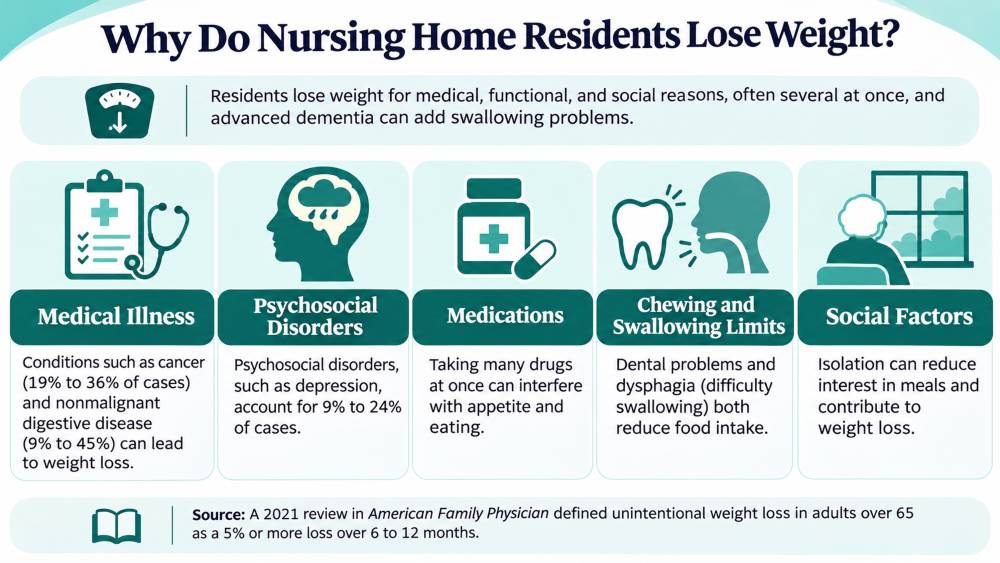
Residents lose weight for medical, functional, and social reasons, often several at once, and advanced dementia can add swallowing problems.
A 2021 review in American Family Physician defined unintentional weight loss in adults over 65 as a loss of 5% or more over 6 to 12 months. The review named these contributors:
The MedlinePlus swallowing page from the National Library of Medicine notes that dysphagia is more common in older adults. It also notes that dysphagia can follow a stroke or Parkinson’s disease.
If you’re ready to get started, call us now!
Weight loss in a skilled nursing facility belongs to the whole interdisciplinary team, because each discipline sees a different part of the problem.
Federal care-planning rules require a member of the food and nutrition staff to be on the team that writes each resident’s care plan. The attending physician, a registered nurse, and a nurse aide sit on the same team.
| Care Team Member | Role When a Resident Loses Weight | Basis |
| Attending physician | Prescribes any therapeutic diet and confirms the medical significance of a change | 42 CFR 483.60(e); federal care-plan team rules |
| Dietitian | Plans meals that follow the diet order and reviews menus for nutritional adequacy | 42 CFR 483.60(c); Sadie G. Mays dining services |
| Registered nurse and nurse aide | Coordinate assessment and provide daily observation | Federal care-plan team rules |
| Speech-language pathologist | Evaluates swallowing and, based on that evaluation, may recommend texture or liquid changes | Sadie G. Mays speech therapy |
| Occupational therapist | Helps residents eat more independently | Sadie G. Mays occupational therapy |
| Resident and family | Share food preferences, allergies, eating history, and goals | 42 CFR 483.60(d); 42 CFR 483.10(c) |
Physical, occupational, and speech therapists at Sadie G. Mays provide rehabilitative services in-house seven days a week under one shared care plan.
Speech therapists there work with the dietary team on food textures and train nursing staff on safe feeding techniques.
The care team responds by confirming the loss, identifying the cause, and adjusting the care plan accordingly. Families do not need to wait for an MDS threshold. Under 42 CFR 483.10(c)(2), the resident can request a care plan meeting or a revision.
The nurse aide on the care team provides day-to-day observation, and the registered nurse coordinates the assessment that documents the resident’s condition. Sadie G. Mays includes nutrition screening, routine assessments, and monitoring meal tolerance as part of its dining department services.
The 2021 American Family Physician review advises treating the underlying cause when one is known. At Sadie G. Mays, a speech therapy evaluation includes a swallowing assessment. Any changes to food texture or liquids depend on that individual assessment and the physician’s diet order.
Weight loss alone does not automatically count as a significant change in status. Under 42 CFR 483.20(b)(2)(ii), a significant change must meet three conditions:
The facility has 14 calendar days to complete a comprehensive assessment. The clock starts when the facility determines, or should have determined, that such a change occurred.
Based on the assessment, the team can change food texture, meal timing, the therapeutic diet, eating assistance, or therapy referrals. Under 42 CFR 483.10(c)(2), the resident and representative must be told in advance about care plan changes and have the right to see the plan.
Families comparing facilities can ask the Sadie G. Mays admissions team how dietitians, nurses, and therapists share one care plan. Call 678-420-2946.
The kitchen can change what it serves, when it serves it, and how it prepares it, within federal food and nutrition rules. Federal rule 42 CFR 483.60 sets these requirements that matter when a resident is losing weight:
Sadie G. Mays serves three meals and two snacks a day from dietitian-planned menus prepared under a chef.
The 2021 American Family Physician review cites an American Geriatrics Society recommendation against prescription appetite stimulants or high-calorie supplements for poor appetite in older adults.
The recommendation favors feeding assistance, appealing food, social support, and stopping medications that interfere with eating.
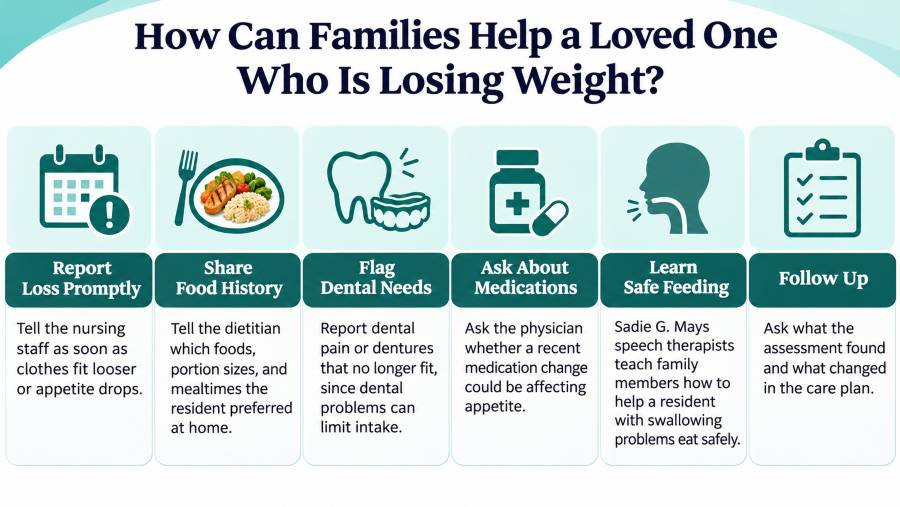
Families help by sharing what staff cannot see in the medical chart and by reporting changes early. Families of current residents bring clinical concerns to the nursing staff. The admissions team answers questions about long-term care admission. Families can help in these ways:
Residents who finish formal therapy can keep practicing safe eating and swallowing methods through restorative nursing. An RN designs and periodically evaluates each restorative nursing program.
How much weight loss is considered significant in a nursing home?
The federal MDS assessment codes a loss of 5% or more in 30 days, or 10% or more in 180 days. For a 150-pound resident, 5% equals 7.5 pounds. A smaller but steady loss is still worth raising with the care team.
What causes elderly nursing home residents to stop eating?
Common causes include medical illness, psychosocial disorders, medications, dental problems, swallowing difficulty, and isolation. A 2021 American Family Physician review found no identifiable cause in 6% to 28% of older adults with unintentional weight loss, so evaluation can continue for several months.
Who decides if a resident needs a special diet?
The attending physician prescribes a therapeutic diet under federal rule 42 CFR 483.60(e). The physician may delegate the prescribing task to a registered or licensed dietitian only to the extent permitted by state law. The dietitian then plans meals that follow the diet order.
What does a speech therapist do for a resident losing weight?
A speech-language pathologist evaluates how safely the resident swallows. Based on that individual evaluation, the therapist may recommend softer foods or thickened liquids. Sadie G. Mays speech therapists work with the dietary team on any texture change the plan calls for.
Can a nursing home resident refuse to eat?
Yes. Federal rule 42 CFR 483.25(g) does not require a facility to keep normal weight when the resident’s preferences indicate otherwise. The facility must still offer an appealing substitute with comparable nutrition to any resident who turns down the meal first served.
Do nutritional supplements help nursing home residents gain weight?
The American Geriatrics Society recommends against prescription appetite stimulants or high-calorie supplements for treating poor appetite in older adults, according to a 2021 American Family Physician review. The recommended focus is feeding assistance, appealing food, social support, and medication review.
Does weight loss automatically trigger a new assessment?
No. Under 42 CFR 483.20(b)(2)(ii), the 14-day clock for a comprehensive assessment starts when the facility determines, or should have determined, that a significant change occurred. That change must affect more than one area of the resident’s health and require a review of the interdisciplinary care plan.
What should families ask when a loved one is losing weight?
Families can ask how much weight was lost and over what period, whether medications changed recently, whether a swallowing evaluation is needed, and what changed in the meal plan. Asking when weight will be rechecked also sets a clear follow-up point.
Nursing home weight loss is a care-team problem, not only a menu problem. Families do not need to wait for an assessment threshold to speak up.
Reporting early, sharing food history, and asking what the assessment found give the dietitian, nurses, physician, and therapists what they need to adjust the care plan.
A parent’s move to skilled nursing raises hard questions. The Sadie G. Mays admissions team walks families through admission steps and care options. Call 678-420-2946.