
What Happens When Private Funds Run Out in a Georgia Nursing Home
Originally published: July 2026 | Reviewed by Sadie Mays

Originally published: July 2026 | Reviewed by Sadie Mays

Private-pay nursing home residents in Georgia who deplete their savings do not lose their bed overnight. Georgia Medicaid covers long-term skilled nursing care with no daily limit once a resident meets 2026 eligibility thresholds — $2,982 per month in income and $2,000 in countable assets.
Families who start planning the financial transition six to twelve months before funds run out avoid coverage gaps, discharge threats, and Medicaid penalty periods that can cost tens of thousands of dollars.
Running out of savings should never mean losing your bed. The Sadie G. Mays admissions team coordinates Medicaid-pending placements for Atlanta families. Call (404) 794-2477 today.
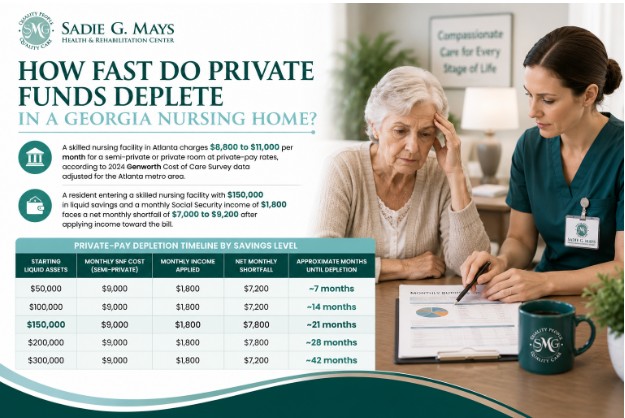
A skilled nursing facility in Atlanta charges $8,800 to $11,000 per month for a semi-private or private room at private-pay rates, according to 2024 Genworth Cost of Care Survey data adjusted for the Atlanta metro area.
A resident entering a skilled nursing facility with $150,000 in liquid savings and a monthly Social Security income of $1,800 faces a net monthly shortfall of $7,000 to $9,200 after applying income toward the bill.
| Starting Liquid Assets | Monthly SNF Cost (Semi-Private) | Monthly Income Applied | Net Monthly Shortfall | Approximate Months Until Depletion |
| $50,000 | $9,000 | $1,800 | $7,200 | ~7 months |
| $100,000 | $9,000 | $1,800 | $7,200 | ~14 months |
| $150,000 | $9,000 | $1,800 | $7,200 | ~21 months |
| $200,000 | $9,000 | $1,800 | $7,200 | ~28 months |
| $300,000 | $9,000 | $1,800 | $7,200 | ~42 months |
Specialty services — wound care, IV therapy, dialysis, and behavioral health interventions — incur facility-specific surcharges in addition to the base room rate.
Families who budget only for the quoted daily rate discover that the actual monthly bill arrives significantly higher than projected, accelerating the depletion timeline by several months.
A Georgia nursing home cannot remove a resident without complying with federal and state discharge procedures, even if the resident has exhausted private funds. Federal regulations under 42 CFR § 483.15 require nursing facilities to provide a minimum of 30 days’ written discharge notice before any involuntary transfer.
The written notice must include the specific reason for the discharge, the location to which the resident will be transferred, a summary of the resident’s current medical and mental health status, a post-discharge care plan, and information on how to appeal the discharge decision.
Georgia nursing home residents have the right to appeal any involuntary discharge through the Georgia Department of Community Health’s fair hearing process. Filing an appeal within 30 days of receiving the discharge notice can delay the transfer until the hearing is resolved.
The receiving facility named in the discharge plan must also agree to accept the resident before the transfer can proceed — a requirement that prevents facilities from discharging residents with no confirmed destination.
Nonprofit skilled nursing facilities that accept Medicaid — including Sadie G. Mays Health & Rehabilitation Center — typically allow residents to remain in their bed while a Medicaid application is pending review.
Medicaid-pending residents continue receiving the same level of skilled nursing care during the application processing period, so the family does not face a gap in coverage between running out of private funds and receiving Medicaid approval.
If you’re ready to get started, call us now!
Georgia Medicaid spend-down is the controlled process of reducing countable assets to $2,000 or below so the nursing home resident meets Georgia’s financial eligibility threshold for Nursing Home Medicaid.
Spend-down does not mean wasting money — Georgia allows applicants to use excess assets for specific purposes without triggering look-back penalties.
Georgia Medicaid permits applicants to spend excess countable assets on paying off existing debts including mortgages and credit cards, prepaying funeral and burial expenses through an irrevocable funeral trust up to $10,000, purchasing a Medicaid-compliant vehicle for the community spouse, making home repairs or modifications to the primary residence, paying outstanding medical bills and health insurance premiums, and purchasing household furnishings or personal items classified as exempt assets.
Every dollar spent during the spend-down process must be documented with receipts, bank statements, and written records.
The Georgia Division of Family and Children Services reviews five years of financial transactions during the application process, and undocumented spending raises red flags that delay Medicaid approval by weeks or months.
Georgia caps Nursing Home Medicaid income eligibility at $2,982 per month (300% of the 2026 Federal Benefit Rate). Applicants whose income exceeds $2,982 — from Social Security, pensions, IRA distributions, or rental income combined — must establish a Qualified Income Trust, also called a Miller Trust.
The QIT is an irrevocable trust that receives the excess monthly income above $2,982. The trust disburses funds only for approved purposes: the resident’s personal needs allowance, Medicare premium payments, spousal maintenance allowance, and uncovered medical expenses.
Any funds remaining in the QIT at the resident’s death revert to the Georgia Medicaid program.
Georgia’s Medicaid look-back period reviews all financial transactions made by the applicant and the applicant’s spouse within 60 months (5 years) prior to the Medicaid application date.
Transfers of assets for less than fair market value during that window trigger a penalty period of Medicaid ineligibility, leaving the family responsible for full private-pay nursing home costs.
Georgia calculates the penalty period by dividing the total uncompensated transfer amount by the state’s average monthly private-pay nursing home cost, which the Georgia Department of Community Health sets at approximately $7,500 for 2026.
| Uncompensated Transfer Amount | Georgia Penalty Divisor (2026) | Resulting Penalty Period |
| $25,000 | $7,500/month | ~3.3 months |
| $50,000 | $7,500/month | ~6.7 months |
| $75,000 | $7,500/month | ~10 months |
| $100,000 | $7,500/month | ~13.3 months |
| $150,000 | $7,500/month | ~20 months |
The penalty period begins on the date the applicant becomes “otherwise eligible” for Medicaid — meaning the applicant has already spent down to $2,000 in assets and meets all other requirements.
The penalty does not begin on the date of the original transfer. A family that gifted $100,000 three years before applying for Medicaid faces 13.3 months of ineligibility starting on the day their parent would otherwise have qualified, creating a devastating funding gap during which someone must pay the full private-pay facility rate.
Georgia exempts specific transfers from look-back penalties under 42 USC § 1396p(c): transfers to a spouse or for a spouse’s sole benefit up to the Community Spouse Resource Allowance, transfers to a blind or permanently disabled child of any age, transfers of the home to a sibling who has an equity interest and lived in the home for at least one year before the applicant’s institutionalization, and transfers of the home to an adult child who lived in the home for at least two years immediately before the parent entered the nursing facility and provided documented care that delayed institutionalization.
Medicaid penalty periods cost Georgia families tens of thousands in avoidable bills. Sadie G. Mays coordinates Medicaid-pending placements and elder law referrals. Start planning today.
The Community Spouse Resource Allowance protects the at-home spouse from financial devastation when one spouse enters a Georgia nursing home and applies for Medicaid. Georgia sets the 2026 CSRA at up to $162,660 in countable assets that the community spouse retains without affecting the applicant spouse’s Medicaid eligibility.
Georgia Medicaid treats all assets owned by either spouse as jointly held for eligibility purposes.
The applicant spouse must reduce countable assets to $2,000, but the community spouse’s protected assets include up to $162,660 in countable assets (bank accounts, investments, retirement accounts in payout status), the primary home regardless of value up to Georgia’s $730,000 home equity cap, one vehicle, personal belongings and household furnishings, and an irrevocable burial trust up to $10,000.
The community spouse also receives a Minimum Monthly Maintenance Needs Allowance of at least $2,643.75 per month (2026 figure).
Georgia Medicaid diverts a portion of the nursing home resident’s income to the community spouse if the community spouse’s own income falls below this threshold, so the at-home spouse maintains a livable monthly income even while the resident’s remaining income goes toward the nursing home bill.
Families with retirement accounts in both names, jointly held real estate, business interests, or assets that straddle the CSRA threshold should consult a Georgia elder law attorney before filing the Medicaid application. Misallocating assets between spouses during the application process can reduce the community spouse’s protected amount below the maximum CSRA, leaving thousands of dollars unprotected.
The State Bar of Georgia maintains a directory of certified elder law attorneys practicing across the state.
If you’re ready to get started, call us now!
Families should begin the Medicaid planning conversation when the nursing home resident’s remaining liquid assets project to cover 12 months or fewer of private-pay care at current facility rates.
Starting 12 months before projected depletion provides enough time to consult an elder law attorney, compile five years of financial records, complete the spend-down process, and file the Medicaid application with the county DFCS office.
Georgia Medicaid applications for nursing facility coverage take 45 to 90 days to be processed by the county Division of Family and Children Services.
Filing the application at least 90 days before projected fund depletion prevents a gap between the last private-pay month and the first Medicaid-covered month.
Families who wait until funds are already exhausted face the full 45-to-90-day processing window with no income source to cover the facility bill — a gap that creates discharge risk and financial hardship.
The first step is to request an itemized financial projection from the facility’s billing department that shows the current monthly rate, projected specialty charges, and the estimated number of months remaining at the current rate of spend-down.
The second step is confirming that the current facility accepts Medicaid and has available Medicaid-certified beds.
The third step is scheduling a consultation with a Georgia elder law attorney to review asset allocation, look-back compliance, and CSRA optimization before any Medicaid application is filed.
The Atlanta Regional Commission Area Agency on Aging provides free benefits counseling covering Medicare, Medicaid, and veterans’ benefit eligibility for families in the metro Atlanta area.
Can a Georgia nursing home evict a resident who runs out of money?
Georgia nursing homes must provide 30-day written notice before any involuntary discharge for nonpayment under 42 CFR § 483.15. The resident or family can appeal through Georgia’s fair hearing process, and the facility must confirm that an approved receiving location has been identified before completing the transfer.
Does Georgia Medicaid pay for nursing home care after private funds are gone?
Georgia Medicaid covers 100% of skilled nursing facility costs once a resident meets the $2,982 monthly income and $2,000 asset limits under 2026 Georgia DCH thresholds. Applicants above the income cap can qualify by establishing a Qualified Income Trust that redirects excess income.
How long does a Georgia Medicaid nursing home application take?
Georgia Medicaid applications for nursing facility coverage typically take 45 to 90 days to process through the county Division of Family and Children Services. Complex applications involving asset transfers or Qualified Income Trusts may take longer than 90 days when additional documentation is required.
What is the Georgia Medicaid look-back period for nursing home care?
Georgia enforces a 60-month look-back period for all Nursing Home Medicaid applications under the federal Deficit Reduction Act of 2005. Asset transfers below fair market value during that window trigger a penalty period calculated at Georgia’s $7,500 monthly penalty divisor.
Can the community spouse keep the house when one spouse enters a Georgia nursing home?
Georgia Medicaid exempts the primary residence from the applicant’s $2,000 asset limit as long as the community spouse or a dependent lives in the home or the applicant expresses intent to return. The home equity cap for Georgia Medicaid eligibility is $730,000 in 2026.
What assets does Georgia Medicaid count toward the $2,000 limit?
Georgia Medicaid counts bank accounts, investments, cash, stocks, bonds, certificates of deposit, non-primary real estate, and retirement accounts not in payout status. Exempt assets include the primary home, one vehicle, personal belongings, household furnishings, and irrevocable burial trusts up to $10,000.
Does Georgia Medicaid take the house after the nursing home resident dies?
Georgia’s Estate Recovery Program seeks reimbursement from the probate estate of a deceased Medicaid recipient for long-term care costs incurred after May 3, 2006. Estates valued at less than $25,000 are exempt, and recovery is deferred while a surviving spouse or dependent child is living.
What is a Qualified Income Trust in Georgia?
A Qualified Income Trust — also called a Miller Trust — allows Georgia Medicaid applicants with monthly income above $2,982 to qualify for Nursing Home Medicaid by diverting excess income into an irrevocable trust. The trust distributes funds only for approved purposes, including Medicare premiums and spousal maintenance.
Will my parent have to change nursing homes when switching from private pay to Medicaid?
A resident does not have to transfer facilities if the current nursing home accepts Medicaid and has Medicaid-certified beds available. Families should confirm Medicaid acceptance with the facility’s admissions office before the private-pay period ends so the resident can remain in place during and after the Medicaid application process.
How much can the community spouse keep under Georgia Medicaid in 2026?
The community spouse retains up to $162,660 in countable assets under the 2026 Community Spouse Resource Allowance, plus the primary home, one vehicle, and personal belongings. The community spouse also receives a Minimum Monthly Maintenance Needs Allowance of at least $2,643.75 per month.
Your parent’s care should never depend on whether the savings last. Sadie G. Mays accepts Medicaid and coordinates every step of the financial transition. Call (404) 794-2477 now.