
Veterans Benefits for Nursing Home Care in Georgia: Complete Guide to VA Coverage and Aid
Originally published: October 2025 | Updated: July 2026 | Reviewed by Sadie Mays

Originally published: October 2025 | Updated: July 2026 | Reviewed by Sadie Mays

Georgia veterans have multiple pathways to reduce or eliminate nursing home costs through federal and state benefit programs.
The VA covers long-term care for enrolled veterans when a clinical need is documented, with options ranging from VA Community Living Centers and contracted community nursing homes to state veterans homes in Augusta and Milledgeville.
The Aid & Attendance pension amounts to $2,424 per month for qualifying wartime veterans. The Atlanta VA Health Care System in Decatur operates a 120-bed Community Living Center and coordinates referrals to community nursing facilities across a 50-county service area.
The Department of Veterans Affairs funds nursing home care through three primary settings, each with different eligibility thresholds, geographic availability, and cost structures.
Understanding which program fits a veteran’s clinical and financial situation is the first step toward reducing out-of-pocket expenses.
VA Community Living Centers (CLCs) are skilled nursing units operated inside VA medical centers. Georgia has four CLCs — at the Atlanta VAMC in Decatur, the Charlie Norwood VAMC in Augusta, the Carl Vinson VAMC in Dublin, and the Trinka Davis Veterans Village in Carrollton. CLCs provide 24-hour nursing supervision, rehabilitation therapy, and end-of-life care.
Veterans with a service-connected disability rating of 70% or higher, or those needing care for a service-connected condition, receive mandatory admission when beds are available. Other enrolled veterans may qualify based on clinical need and income.
Community Nursing Home (CNH) contracts allow the VA to place veterans in private nursing facilities when CLC beds are full or when a veteran lives too far from a VA facility. The VA contracts with state-inspected nursing homes throughout Georgia to deliver this care. CNH placements require a VA clinical assessment confirming the veteran needs skilled nursing and cannot safely remain at home. Geographic proximity to family is a placement factor.
State Veterans Homes in Augusta and Milledgeville operate as partnerships between the Georgia Department of Veterans Service and the VA. These facilities charge a daily fee that is partially offset by federal VA funding — and is fully waived for veterans with a 70%+ service-connected disability rating.
Both homes provide skilled nursing, and the Aid & Attendance pension can cover most or all of the remaining daily fee for veterans who qualify.
Veterans unsure whether they qualify for skilled nursing or assisted living should request a VA Geriatric and Extended Care referral through their VA primary care team.
The referral triggers a comprehensive assessment that determines not just eligibility but the most appropriate level of care.
If you’re ready to get started, call us now!
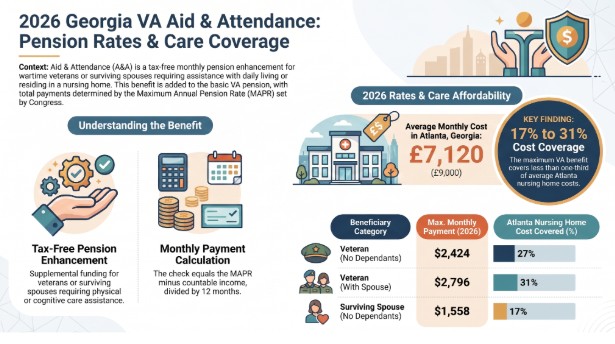
Aid & Attendance (A&A) is a tax-free monthly pension enhancement for wartime veterans — or their surviving spouses — who need help with activities of daily living or who reside in a nursing home due to physical or cognitive incapacity. It is not a standalone benefit. A&A is added to the basic VA pension, and the combined payment is calculated against a Maximum Annual Pension Rate (MAPR) ceiling set by Congress each year.
The veteran’s actual monthly check equals the MAPR minus countable annual income, divided by 12.
For the benefit year running December 1, 2025 through November 30, 2026, the VA’s published MAPR rates for pension with Aid & Attendance are as follows:
| Beneficiary Category | 2026 MAPR (Annual) | 2026 Maximum Monthly | Coverage as % of Atlanta Semi-Private Room ($9,000/mo avg.) |
| Veteran, no dependents | $29,093 | $2,424 | 27% |
| Veteran, one dependent (spouse) | $33,548 | $2,796 | 31% |
| Surviving spouse, no dependents | $18,697 | $1,558 | 17% |
| Surviving spouse, one dependent | $22,304 | $1,859 | 21% |
These are maximum ceilings. Every dollar of countable income — Social Security, private pension, investment returns — reduces the payment dollar-for-dollar.
However, unreimbursed medical expenses (UMEs), including nursing home costs, home care fees, and Medicare premiums, can significantly reduce countable income, often pushing the actual benefit closer to the MAPR ceiling for veterans with high care costs.
The application requires VA Form 21P-527EZ (pension application), VA Form 21-2680 (physician’s examination documenting care needs), a DD-214, and financial documentation.
Processing typically takes 6–12 months, though filing a Fully Developed Claim with complete documentation can shorten the timeline. Benefits are retroactive to the application date or the date eligibility began, whichever is later.
For Georgia families comparing long-term care costs in the Atlanta area, A&A alone does not cover the full cost of a private nursing home room.
However, when stacked with Social Security, VA disability compensation (if the veteran elects pension over compensation), and Medicaid, the coverage gap narrows substantially.
Veterans already receiving VA disability compensation at any rating cannot receive VA pension simultaneously — only the higher of the two is payable.
Georgia operates two state war veterans homes — the Georgia War Veterans Home in Milledgeville and the Georgia War Veterans Nursing Home in Augusta.
Both facilities provide skilled nursing care exclusively to eligible veterans under a partnership between the Georgia Department of Veterans Service and the federal VA. A nominal daily fee is charged, but federal benefits can reduce or eliminate that cost entirely.
Residency and service requirements are strict. Applicants must be current Georgia residents who have lived in the state for at least two years immediately before applying, or for five of the past 15 years.
Wartime service during a federally recognized conflict is mandatory. Discharge must be under honorable or other-than-honorable conditions. All branches of service qualify as long as the wartime service requirement is met.
Daily fee structure depends on the veteran’s federal benefit status:
Transferring from a private facility to a state veterans home is possible when beds open up. Federal benefits — A&A, disability compensation, pension payments — follow the veteran to the new facility.
Families should apply to a state home while maintaining current care arrangements, since waitlists are common when beds are at capacity.
Social workers at both the current facility and the state home coordinate discharge summaries, benefit verification letters, and medical records to prevent coverage gaps during the transition.
Veterans currently in a private nursing home in Atlanta who want to explore whether a state home could lower their costs should contact the GDVS field office at the Decatur VA campus. An accredited Veterans Service Officer can review eligibility and initiate the application at no charge.
The Joseph Maxwell Cleland Atlanta VA Medical Center sits on 26 acres at 1670 Clairmont Road in Decatur, just east of downtown Atlanta. It is the anchor facility of the Atlanta VA Health Care System, a Level 1A tertiary care network that serves over 130,000 enrolled veterans across 50 counties in northeast Georgia.
For families navigating the transition from hospital to nursing home, this system is the primary gateway to VA-funded long-term care in the metro Atlanta region.
The Community Living Center (CLC) at the Atlanta VAMC operates 120 beds, providing skilled nursing, short-term rehabilitation, and end-of-life care under one roof. Veterans discharged from the medical center’s acute care wards can transfer directly to the CLC when a clinical assessment confirms the need for ongoing skilled nursing or rehabilitation services.
The CLC also accepts referrals from community hospitals when the veteran is enrolled in VA health care and meets the clinical threshold.
Twenty-one community-based outpatient clinics (CBOCs) extend the system’s reach across metro Atlanta and northeast Georgia, with locations in Brookhaven, Lawrenceville, Marietta, East Point, Stockbridge, Carrollton, Rome, and other communities.
Veterans receiving primary care at any CBOC can request a Geriatric and Extended Care evaluation to determine eligibility for long-term care. The Trinka Davis Veterans Village in Carrollton also operates a 27-bed CLC for veterans in the western suburbs who need skilled nursing closer to home.
VA Community Care referrals are processed through the Atlanta VAMC when the system cannot provide timely in-house care. Current VA access standards require non-institutional extended care to be available within 20 days and a 30-minute drive.
If the Atlanta CLC or other VA facilities cannot meet those standards, the VA issues a community care authorization allowing the veteran to receive nursing home care at a contracted private facility — including community-based skilled nursing facilities in the Atlanta area.
If you’re ready to get started, call us now!
Most veterans use more than one funding source to cover the full cost of nursing home care. VA benefits rarely pay 100% of a private facility’s daily rate unless the veteran has a 70%+ service-connected disability and is placed in a VA-owned CLC or state veterans home.
For everyone else, understanding how payment layers stack is essential to avoiding coverage gaps and unexpected bills.
VA health care and Medicaid can work together, but coordination matters. Medicaid may cover nursing home costs that VA benefits do not — including room and board beyond what the VA pays, personal needs allowances, and additional home health aide hours.
Georgia Medicaid eligibility for institutional care requires income below $2,982 per month and countable assets below $2,000 (2026 thresholds). Veterans already enrolled in VA health care can apply for Medicaid simultaneously, and the two programs share billing to prevent duplicate payments.
Aid & Attendance and Medicaid interact in a specific way. If a veteran receives Medicaid-covered nursing home care, the VA reduces the A&A pension to $90 per month. This means A&A is most financially valuable when the veteran is paying out of pocket or using private insurance — not when Medicaid is the primary payer.
Families should calculate whether applying for Medicaid before or after A&A produces a better net financial outcome.
Private long-term care insurance typically pays before VA benefits. If a veteran holds a long-term care policy, the insurer pays first. VA benefits and Medicaid fill the remaining gaps. Veterans with private insurance should confirm whether their policy coordinates with VA payments or treats them as duplicate coverage.
Home and community-based alternatives can delay or prevent the need for full nursing home placement. The VA’s home health versus skilled nursing evaluation determines whether a veteran can safely remain at home with support services — including home health aides, adult day health care, respite care for family caregivers, and veteran-directed care programs that let veterans hire their own caregivers.
Community care services are available through the Atlanta VAMC when in-house capacity is limited.
Sadie G. Mays helps Georgia veterans and families coordinate VA, Medicaid, and private coverage — call (404) 794-2477 to speak with our admissions team.
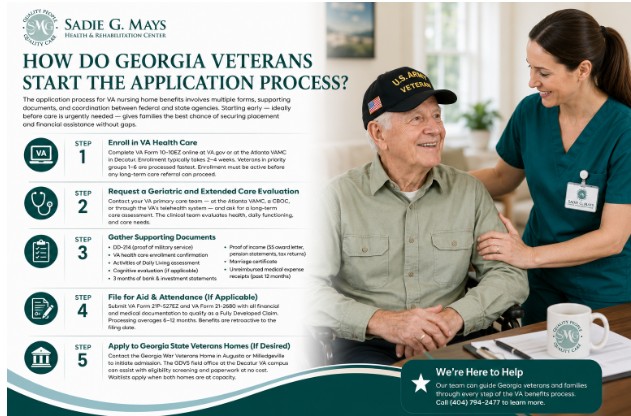
The application process for VA nursing home benefits involves multiple forms, supporting documents, and coordination between federal and state agencies. Starting early — ideally before care is urgently needed — gives families the best chance of securing placement and financial assistance without gaps.
Step 1: Enroll in VA health care. Complete VA Form 10-10EZ online at VA.gov or at the Atlanta VAMC in Decatur. Enrollment typically takes 2–4 weeks. Veterans in priority groups 1–6 (including those with service-connected disabilities, low income, or combat-era service) are processed fastest. Enrollment must be active before any long-term care referral can proceed.
Step 2: Request a Geriatric and Extended Care evaluation. Contact your VA primary care team — at the Atlanta VAMC, a CBOC, or through the VA’s telehealth system — and ask for a long-term care assessment. The clinical team evaluates functional status, cognitive health, medical complexity, and whether rehabilitation services might restore enough independence to delay nursing home placement.
Step 3: Gather supporting documents. The following records are needed across most VA and state home applications:
Step 4: File for Aid & Attendance (if applicable). Submit VA Form 21P-527EZ and VA Form 21-2680 simultaneously. Include all financial and medical documentation at initial filing to qualify as a Fully Developed Claim. Processing averages 6–12 months. Benefits are retroactive to the filing date.
Step 5: Apply to Georgia State Veterans Homes (if desired). Contact the Georgia War Veterans Home in Augusta or Milledgeville directly to initiate admission. The GDVS field office at the Decatur VA campus can assist with eligibility screening and paperwork at no cost. Waitlists apply when both homes are at capacity.
Veterans who need placement urgently — such as those being discharged from a hospital — should notify the hospital discharge planner that they are VA-enrolled.
The VA can authorize temporary community nursing home care while a permanent CLC or state home bed becomes available. This prevents the veteran from going without covered care during the transition.
Sadie G. Mays helps Georgia veterans navigate VA admissions, benefit coordination, and long-term care placement with experienced support. Contact our admissions team — call (404) 794-2477.
What VA benefits cover nursing home care for veterans in Georgia?
The VA covers nursing home care through Community Living Centers at VA medical centers, contracted community nursing homes, and Georgia’s two state veterans homes in Augusta and Milledgeville. Enrolled veterans with documented clinical need qualify, with priority given to those rated 70% or higher service-connected disability.
What is the Aid & Attendance benefit and how much does it pay in 2026?
Aid & Attendance is a tax-free VA pension enhancement for wartime veterans needing help with daily activities. In 2026, the maximum monthly payment is $2,424 for a single veteran or $2,796 for a veteran with a spouse, calculated against the MAPR.
Does the VA pay 100% of nursing home costs for all eligible Georgia veterans?
No. The VA pays full nursing home costs only for veterans with a 70% or higher service-connected disability rating or those needing care for a service-connected condition. Other veterans may owe copays after day 21, calculated based on income and assets.
What is the net worth limit for VA pension eligibility in 2026?
The net worth limit is $163,699 for the December 2025 through November 2026 benefit year. Net worth includes countable assets plus annual income but excludes the primary residence, one vehicle, and personal belongings. The VA also enforces a 36-month look-back on transfers.
How does the Atlanta VA Medical Center help veterans access long-term care?
The Joseph Maxwell Cleland Atlanta VAMC in Decatur operates a 120-bed Community Living Center and coordinates long-term care referrals through 21 outpatient clinics across 50 counties. Veterans can request a Geriatric and Extended Care evaluation through their VA primary care team.
Can Georgia veterans receive both Aid & Attendance and Medicaid for nursing home care?
Yes, but the VA reduces Aid & Attendance pension to $90 per month when Medicaid pays for nursing home care. A&A delivers the most financial value when the veteran pays out of pocket or uses private insurance as the primary payer rather than Medicaid.
What are the eligibility requirements for Georgia’s state war veterans’ homes?
Applicants must be Georgia residents for two consecutive years or five of the past fifteen, have wartime service with an honorable or other-than-dishonorable discharge, and meet clinical criteria for skilled nursing care. Veterans rated at 70% or higher service-connected disability pay no daily fee.
How long does it take to get approved for VA Aid & Attendance in Georgia?
Processing typically takes 6 to 12 months. Filing a Fully Developed Claim with complete medical documentation, financial records, and VA Form 21-2680 can shorten the timeline. Benefits are paid retroactively to the application date or the date eligibility began, whichever is later.
What community care options exist for Georgia veterans who are not ready for a nursing home?
The VA funds home health aides, adult day health care, respite care for family caregivers, and veteran-directed care programs through its Community Care network. Veterans qualify when VA facilities cannot provide timely care within 20 days and a 30-minute drive of their home.
How should families coordinate VA benefits with a hospital discharge planner in Atlanta?
Notify the discharge planner that the patient is VA-enrolled and request a referral to the Atlanta VAMC social work team. The VA can authorize temporary placement in a community nursing home while a permanent bed becomes available at a CLC or state veterans home.