
What Should a Nursing Home Know About a Loved One That Isn’t in the Medical Chart?
Originally published: November 2026 | Reviewed by Sadie Mays

Originally published: November 2026 | Reviewed by Sadie Mays

Non-medical information is what a family knows about how a person lives, rather than what is wrong with them: daily routines, communication habits, food preferences, faith practices, life history, and personal goals.
Federal rule 42 CFR 483.20(b)(1) requires a certified nursing facility’s resident assessment to cover strengths, goals, life history, and preferences along with medical needs.
At Sadie G. Mays Health & Rehabilitation Center, a 206-bed skilled nursing facility in Atlanta, Georgia, families can bring that knowledge to admissions and to the facility’s post-admission care conference.
A medical chart records diagnoses, medications, and test results, but it seldom says how a person likes to start the day or what eases a hard moment. Federal assessment rules name several non-medical areas a facility must cover.
Families often hold the details for each one, and the first 72 hours of a stay are a natural time to share them.
| Information Type | What Families Can Share | Federal Rule That Covers It |
| Customary routine | Usual wake time, bedtime, bathing preference, nap habits | 42 CFR 483.20(b)(1)(ii) |
| Communication | Preferred language, hearing or vision aids, how the person signals pain or need | 42 CFR 483.20(b)(1)(iv) |
| Mood and psychosocial well-being | What calms the person, what upsets them, past coping habits | 42 CFR 483.20(b)(1)(vi) and (vii) |
| Activity pursuits | Hobbies, music, reading, worship practices | 42 CFR 483.20(b)(1)(xiii) |
| Food | Favorite foods, dislikes, mealtime habits, allergies | 42 CFR 483.60(d) |
| Life history and goals | Work, family roles, what matters most now | 42 CFR 483.20(b)(1) |
Clinical information tells staff what care a resident needs, while these details tell staff how to deliver it in a way the person recognizes.
Sadie G. Mays provides long-term care and short-term rehabilitation, and the same details matter in both kinds of stay.
A nursing facility collects personal preferences in two ways: a formal assessment interview and ongoing conversation with the resident, family, and staff.
The formal piece is Section F of the Minimum Data Set (MDS), the CMS resident assessment described in the CMS RAI Manual.
Under the current CMS RAI Manual (version 1.20.1), staff interviews the resident about daily and activity preferences unless the resident is rarely or never understood. A family member or significant other answers when the resident is rarely or never understood. Staff completes their own assessment when neither interview can be done.
The CMS Section F items cover choices such as clothing, type of bath, snacks, bedtime, and family involvement in care discussions.
They also cover activities like reading, music, pets, news, time outdoors, and religious services. Those answers matter at Sadie G. Mays, where activities include weekend worship services and in-room visits.
Families do not need to wait for the formal interview. For a parent with advanced memory loss, family input may become the main record of preferences.
Under 42 CFR 483.10(c)(2)(i), the resident can name the people to include in care planning. A family member the resident chooses can then share routines and preferences with the care team at any point.
The assessment also draws on direct observation and on conversations with direct care staff across every shift, under 42 CFR 483.20(b)(1)(xviii).
When MDS answers flag a care area, federal rules require an added assessment of that area and a written summary in the record, under 42 CFR 483.20(b)(1)(xvii).
If you’re ready to get started, call us now!
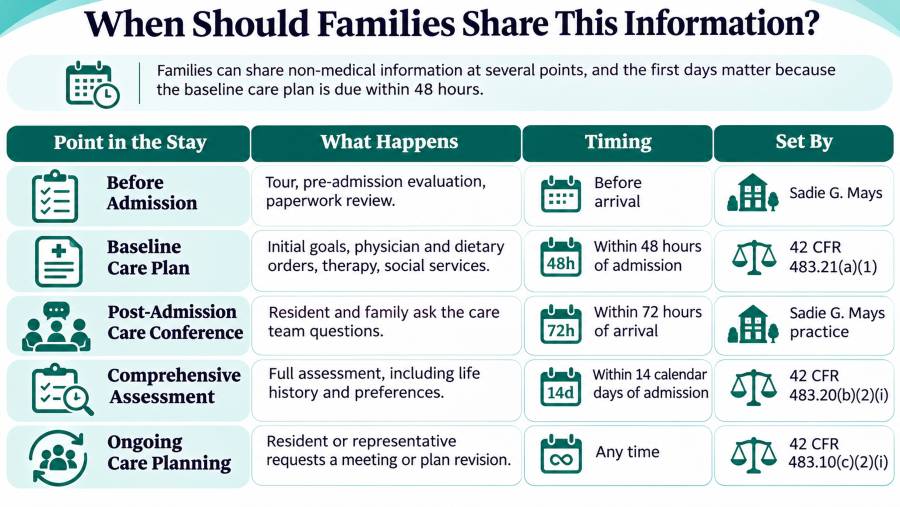
Families can share non-medical information at several points, and the first days matter because the baseline care plan is due within 48 hours. Some checkpoints come from federal rules and others from Sadie G. Mays’ own admissions practice.
| Point in the Stay | What Happens | Timing | Set By |
| Before admission | Tour, pre-admission evaluation, paperwork review | Before arrival | Sadie G. Mays |
| Baseline care plan | Initial goals, physician and dietary orders, therapy, social services | Within 48 hours of admission | 42 CFR 483.21(a)(1) |
| Post-Admission Care Conference | Resident and family ask the care team questions | Within 72 hours of arrival | Sadie G. Mays practice |
| Comprehensive assessment | Full assessment, including life history and preferences | Within 14 calendar days of admission | 42 CFR 483.20(b)(2)(i) |
| Ongoing care planning | Resident requests a meeting or plan revision | Any time | 42 CFR 483.10(c)(2)(i) |
Under 42 CFR 483.21(a)(3), the resident and representative receive a written summary of the baseline care plan. That summary gives families an early chance to check that key preferences made it in.
Families preparing for a move can ask the Sadie G. Mays admissions team how personal details are gathered at admission. Call 678-420-2946.
Personal information shapes daily care by giving the care team the preferences it must plan around. Under 42 CFR 483.10(f)(1), residents may choose activities, schedules, and health care consistent with their interests, assessments, and care plan.
42 CFR 483.10(c)(3)(iii) also requires personal and cultural preferences to be built into goals of care.
Family knowledge reaches daily care through four channels:
A preference shapes the plan rather than overriding it. The rule ties each choice to the resident’s interests, assessments, and care plan, so care plan meetings are where the resident, family, and team work out any conflict.
The facility designs its activities around residents’ needs and interests, including Bible study every two weeks and in-room visits for residents who cannot join group events.
Families can prepare a one-page summary that any caregiver on any shift can read in a minute. Families still deciding on a move can use conversations with a parent to learn which routines matter most first.
Each entry works best when it names the preference, explains why it matters, tells staff what to do, and identifies who to call if it changes.
| Summary Section | What to Write | Sample Entry |
| Preference or routine | The habit in plain words | “Wakes around 6 a.m. and likes coffee before bathing” |
| Why it matters | Comfort, communication, or dignity reason | “Mornings set the mood for the whole day” |
| What staff should know or try | A specific step | “Offer coffee first; bathe after breakfast” |
| Who to contact | The family member the resident named and a phone number | “Daughter, for changes or questions” |
For the care conference after arrival, Sadie G. Mays suggests noting how the person managed at home, the home setup, and discharge hopes. Families should also pack glasses, hearing aids, and dentures, and bring copies of a health care power of attorney or advance directive.
What should families tell a nursing home about a parent?
Families can share daily routines, communication habits, hearing or vision needs, food likes, faith practices, what calms or upsets the person, and life history. Federal rule 42 CFR 483.20(b)(1) requires the comprehensive assessment to cover life history and preferences alongside medical needs.
What information does a nursing home need at admission?
Sadie G. Mays lists a DMA-6 form, medical history and physical exam notes, a Level I screening, and rehab notes after therapy. The facility also suggests families bring notes on home routines, goals, home setup, and discharge hopes to the care conference.
Can families share preferences outside the formal assessment?
Yes. The MDS Section F interview is one formal step, but under 42 CFR 483.10(c)(2)(i), the resident can name people to include in care planning. A family member the resident chooses can share routines and preferences with the care team at any point.
Can a nursing home resident choose when to wake up and go to bed?
Yes, within the care plan. Federal rule 42 CFR 483.10(f)(1) gives residents the right to choose schedules, including sleeping and waking times, consistent with their interests, assessments, and care plan. Care plan meetings are where conflicts in care needs are resolved.
When does a nursing home complete its full assessment?
Federal rule 42 CFR 483.20(b)(2)(i) requires the comprehensive assessment within 14 calendar days after admission. A baseline care plan comes first, within 48 hours under 42 CFR 483.21(a)(1), and Sadie G. Mays holds its own care conference within 72 hours of arrival.
Can family members be part of care plan meetings?
Yes. Under 42 CFR 483.10(c)(2)(i), the resident can name the people to include in care planning, request meetings, and request revisions to the care plan. A resident can request that a family member be involved at any point during the stay.
How can families share information about a parent with dementia?
Families can answer the MDS Section F preference interview when the resident is rarely or never understood. A one-page summary of routines, favorite topics, calming approaches, and known triggers also gives staff on every shift the same details to work from.
What if a parent’s preferences change after admission?
Families can tell the care team and ask for an updated plan. Under 42 CFR 483.10(c)(2), the resident may request a care plan meeting or revision at any time, and the resident must be told in advance about plan changes.
Knowing what to tell a nursing home comes down to one idea: the medical chart covers the condition, and the family covers the person.
Federal rules require the assessment to include life history and preferences. Families can add that knowledge before admission, at the early care conference, during the comprehensive assessment, and at any later care plan meeting.
Every family wants a parent known as a person. The Sadie G. Mays admissions team explains how family knowledge enters care from day one. Call 678-420-2946.