
What to Expect During Admissions at Sadie G. Mays: A Step-by-Step Guide for Families
Originally published: October 2026 | Reviewed by Sadie Mays

Originally published: October 2026 | Reviewed by Sadie Mays

The nursing home admissions process is a series of referral, paperwork, screening, payment, and move-in steps that bring a person from a hospital or home into a skilled nursing facility.
Sadie G. Mays Health & Rehabilitation Center, a 206-bed nonprofit in northwest Atlanta open since 1947, admits new residents seven days a week.
The admissions team handles paperwork before arrival, and the center holds a family care conference within 72 hours.
A hospital discharge date can arrive before families feel ready. The Sadie G. Mays admissions office at 678-420-2946 explains each form and step before transfer.
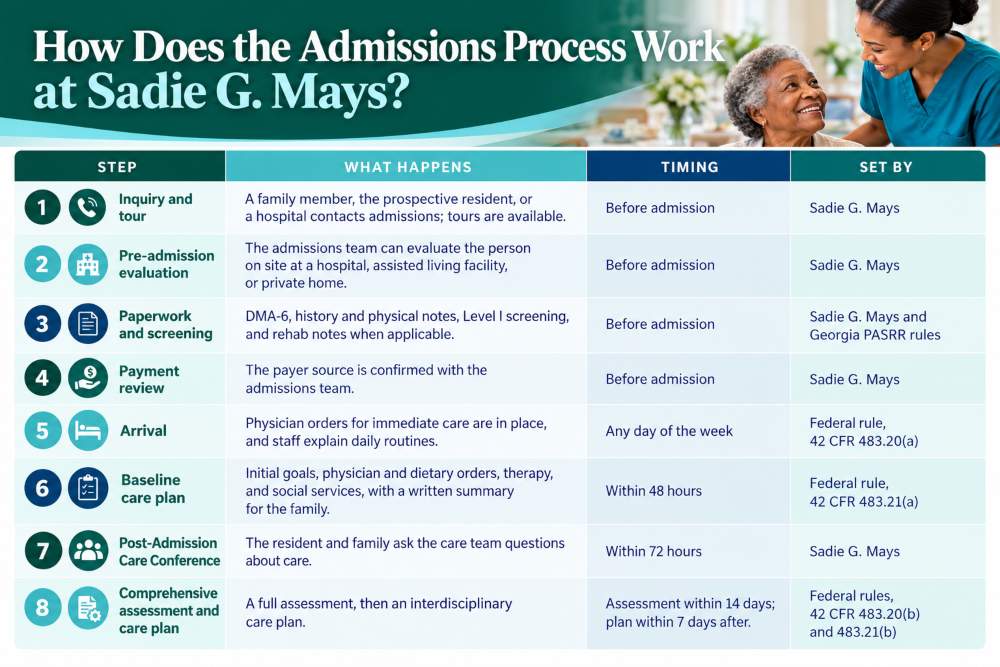
Admission at Sadie G. Mays moves through eight steps, from the first call to a full care plan in the first few weeks. Some steps are the center’s own practice, and others follow federal deadlines that apply to every certified nursing home.
| Step | What Happens | Timing | Set By |
| 1. Inquiry and tour | A family member, the prospective resident, or a hospital contacts admissions; tours are available | Before admission | Sadie G. Mays |
| 2. Pre-admission evaluation | The admissions team can evaluate the person on site at a hospital, assisted living facility, or private home | Before admission | Sadie G. Mays |
| 3. Paperwork and screening | DMA-6, history and physical notes, Level I screening, and rehab notes when applicable | Before admission | Sadie G. Mays and Georgia PASRR rules |
| 4. Payment review | The payer source is confirmed with the admissions team | Before admission | Sadie G. Mays |
| 5. Arrival | Physician orders for immediate care are in place, and staff explain daily routines | Any day of the week | Federal rule, 42 CFR 483.20(a) |
| 6. Baseline care plan | Initial goals, physician and dietary orders, therapy, and social services, with a written summary for the family | Within 48 hours | Federal rule, 42 CFR 483.21(a) |
| 7. Post-Admission Care Conference | The resident and family ask the care team questions about care | Within 72 hours | Sadie G. Mays |
| 8. Comprehensive assessment and care plan | A full assessment, then an interdisciplinary care plan | Assessment within 14 days; plan within 7 days after | Federal rules, 42 CFR 483.20(b) and 483.21(b) |
Families who want to see the building first can schedule an in-person tour or start with the virtual tour of the northwest Atlanta campus.
Sadie G. Mays lists three required items for every admission and a fourth that applies only when the person has been in therapy. Other documents are recommended because they speed up care decisions after arrival.
| Document | Status | Who Usually Provides It |
| DMA-6 physician’s recommendation | Required | The physician completes it; the resident and family also sign at Sadie G. Mays |
| Medical history and physical exam progress notes | Required | The hospital or the person’s physician |
| Level I PASRR screening | Required | The referring provider, often the hospital, submits it, and Georgia Medicaid’s PASRR contractor completes the review |
| Rehabilitation notes | Required when the person has had therapy | The hospital or outpatient therapy provider |
| Photo ID, insurance, Medicare, or Medicaid cards | Recommended | The family |
| Health care power of attorney or advance directive | Recommended | The family |
The DMA-6 is Georgia Medicaid’s physician recommendation form for nursing facility care, and the physician uses it to certify that a person needs that level of care.
Georgia’s Medicaid level-of-care policy treats a completed DMA-6 kept on file at the nursing home as the level-of-care record for nursing home Medicaid.
PASRR, the federal Preadmission Screening and Resident Review program, begins with a Level I screen for everyone applying to a Medicaid-certified nursing facility, including private-pay and hospice applicants. Georgia Medicaid’s PASRR program uses that screen to flag a possible serious mental illness, intellectual disability, or related condition, and a flagged screen leads to a Level II evaluation before admission.
Federal rules exempt a readmission after a hospital transfer from a new preadmission determination, and they let states exempt a direct hospital discharge when the attending physician certifies the person will likely need fewer than 30 days of nursing facility care.
Hospital records give the admitting team its starting picture: diagnoses, the most recent history and physical, progress notes, and any therapy notes.
A hospital discharge planner usually gathers these records for the receiving facility, so families confirm early that the packet includes therapy notes when rehabilitation is part of the plan.
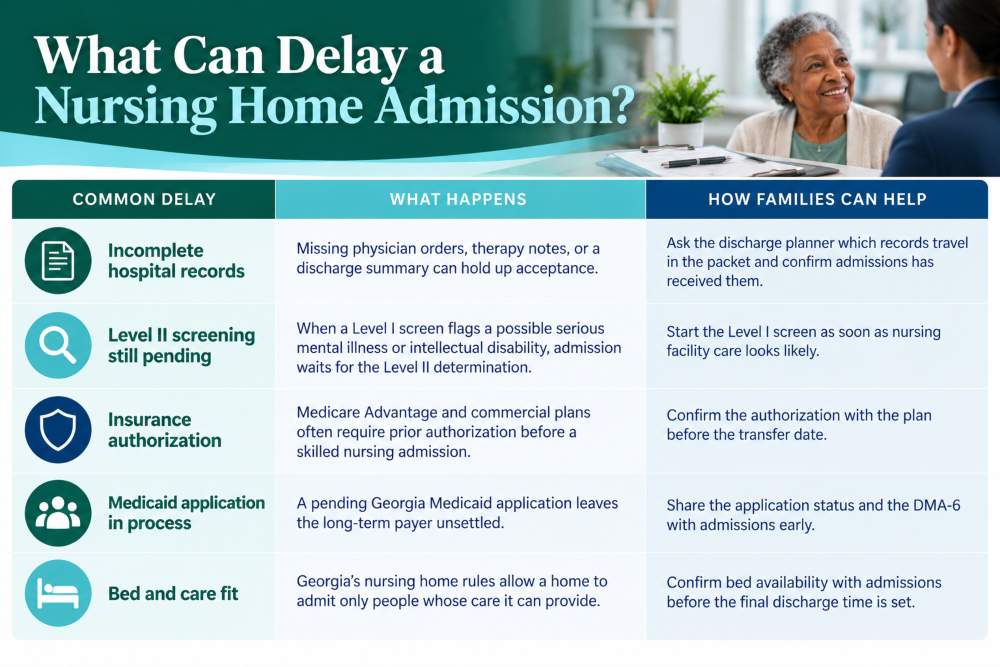
Most admission delays come from missing paperwork, a pending screening, an unsettled payer, or no available bed, and families can head off each one before the hospital sets a discharge time.
Families coordinating these pieces can ask for Admissions Liaison Jessica Maxey, listed on the center’s team roster, when calling the admissions office.
If you’re ready to get started, call us now!
Sadie G. Mays accepts Medicare, Medicaid, VA contract, managed care, third-party payers and other insurance, hospice, and private pay, and the admissions team confirms the payer source before move-in.
Each source carries its own paperwork, so settling the payer early prevents delays on transfer day.
| Payment Source | When It Usually Applies | What Families Have Ready |
| Original Medicare Part A | Short-term skilled nursing or rehab after a qualifying hospital stay | Medicare card and hospital discharge records |
| Medicare Advantage and managed care | Plan members; each plan sets its own cost sharing, may require prior authorization, and may waive the 3-day hospital stay | Plan member card and authorization number |
| Georgia Medicaid | Long-term nursing facility care for people who meet Georgia’s financial and medical criteria | DMA-6 and Medicaid card or pending application |
| VA contract | Veterans whose care is arranged through a VA contract | VA paperwork for the stay |
| Hospice | Residents receiving hospice care at the center | Hospice provider information |
| Private pay | Residents paying from their own funds; Visa, MasterCard, Discover, and American Express accepted | Payment method |
Accepting a payer means Sadie G. Mays can bill that payer. Coverage for a particular stay still depends on the payer’s own decision, such as a Medicare Advantage plan’s authorization or Georgia Medicaid’s eligibility determination.
Long-term residents who move past the Medicare benefit usually rely on Georgia Medicaid, long-term care insurance, or private funds to pay for skilled nursing in Atlanta.
Under Original Medicare, skilled nursing coverage generally requires an inpatient hospital stay of at least 3 consecutive days, including the admission day but not the discharge day.
Time under observation or in the emergency room does not count, even overnight. An approved Accountable Care Organization waiver or a Medicare Advantage plan may remove the 3-day requirement, and the resident generally enters the facility within 30 days of leaving the hospital.
The 100 days are a maximum for each benefit period, not a guaranteed length of stay. Part A pays only while the resident needs daily skilled nursing or therapy, and refusing that daily care can end coverage.
In 2026, days 1 to 20 cost $0 per day once the $1,736 Part A deductible is met (a resident who already paid it for a hospital stay in the same benefit period does not pay it again), and days 21 to 100 cost $217 per day.
A benefit period ends after 60 days in a row without inpatient hospital or skilled nursing care.
Paperwork and payer questions can slow a hospital discharge. Contact admissions at Sadie G. Mays, 678-420-2946, to confirm forms and coverage before transfer.
On admission day, the new resident arrives with physician orders for immediate care, settles into a room, and learns the daily routine.
Federal rule 42 CFR 483.20(a) requires those physician orders to be in place at the moment of admission.
Nursing staff reviews the admission orders, medications, and allergies when the resident arrives. Sadie G. Mays staff also walk the resident and family through daily routines and what life at the center looks like, which eases some of the strain of a new setting.
New residents and families also learn about the Resident’s Council, the Ethics Committee, voter registration, and a list of community resources.
The first two weeks follow a set schedule: a federal baseline care plan within 48 hours, the Sadie G. Mays Post-Admission Care Conference within 72 hours, and a federal comprehensive assessment within 14 calendar days. The full care plan follows within 7 days after that assessment is completed.
Federal rule 42 CFR 483.21 requires a baseline care plan within 48 hours of admission that covers initial goals, physician orders, dietary orders, therapy, social services, and any PASRR recommendation. The resident and representative receive a written summary of that plan, including medications and dietary instructions.
Sadie G. Mays convenes its Post-Admission Care Conference within 72 hours of arrival, where the resident and family ask questions about care.
Families get more from the conference by bringing notes on how the person managed at home before the hospital stay, current goals, home setup, discharge hopes, and any medication or therapy questions.
The first 72 hours also include therapy evaluations for residents admitted for rehabilitation.
Under 42 CFR 483.20(b), a registered nurse coordinates a comprehensive assessment within 14 calendar days of admission, covering cognition, mood, physical function, nutrition, skin condition, medications, and discharge planning.
A readmission after a hospital stay with no significant change in condition does not restart that 14-day assessment. Staff observe the resident directly and speak with direct care staff each shift as part of the assessment.
An interdisciplinary team writes the comprehensive care plan within 7 days after the assessment.
The team includes the attending physician, a registered nurse, a nurse aide, a member of the food and nutrition staff, and, where practicable, the resident and family, and the team revisits the plan in care plan meetings after each later assessment, including quarterly reviews at least every 3 months.
Federal rule 42 CFR 483.15 sets admission protections in every Medicare- or Medicaid-certified nursing home, including Sadie G. Mays. The protections cover what a facility may ask of a family during admission and how it must treat residents once they move in, and each one traces to a specific subsection of the federal rule.
| Protection | What the Rule Provides | Citation |
| Payment guarantee | No third-party guarantee of payment for admission, faster admission, or continued stay; a representative with legal access to the resident’s income may sign to pay from those funds without personal liability | 42 CFR 483.15(a)(3) |
| Benefit waivers | No request to waive resident rights, including Medicare or Medicaid rights, and no request for assurance that the person will not apply for either program | 42 CFR 483.15(a)(2)(i)-(ii) |
| Personal property | No request to waive the facility’s potential liability for lost personal property | 42 CFR 483.15(a)(2)(iii) |
| Medicaid admissions | No gift, donation, or added payment from a Medicaid-eligible person as a condition of admission; charges are allowed only for requested items outside the state plan, with notice, and unrelated-party charitable gifts cannot be a condition of admission | 42 CFR 483.15(a)(4) |
| Advance disclosure | Notice of any special characteristics or service limits before admission | 42 CFR 483.15(a)(6) |
| Equal policies | The same transfer, discharge, and service policies for every resident regardless of payment source | 42 CFR 483.15(b)(1) |
Does Sadie G. Mays admit residents on weekends?
Sadie G. Mays admits new residents seven days a week, including weekends. The admissions team can also evaluate a prospective resident on site at a hospital, an assisted living facility, or a private home before the move. Families can reach admissions at 678-420-2946.
Is admission guaranteed once a hospital sends a referral?
No. Admission depends on an open bed, completed screening and paperwork, a confirmed payer, and the facility’s ability to meet the person’s care needs, which Georgia Rule 111-8-56-.05 requires before any nursing home admits a patient. Families confirm the bed with admissions before discharge.
What is a DMA-6 form in Georgia?
A DMA-6 is Georgia Medicaid’s physician recommendation form for nursing facility care, and the physician uses it to certify that a person needs that level of care. Sadie G. Mays lists a DMA-6 signed by the physician, resident, and family among its pre-admission requirements.
What is a Level I screening for nursing home admission?
A Level I screening is the first stage of PASRR, the federal Preadmission Screening and Resident Review program. Every applicant to a Medicaid-certified Georgia nursing facility completes the screen, and a possible serious mental illness or intellectual disability triggers a more detailed Level II evaluation.
Can a nursing home require a family member to guarantee payment?
No. Under 42 CFR 483.15(a)(3), a nursing home cannot require a third-party guarantee of payment as a condition of admission or continued stay. A representative with legal access to the resident’s income can sign to pay from those funds without personal liability.
What happens at the Post-Admission Care Conference?
Sadie G. Mays holds a Post-Admission Care Conference within 72 hours of arrival, where the resident and family ask the care team questions about care. Families can bring notes on the person’s abilities before the hospital stay, goals, home setup, and discharge hopes.
Does Medicare cover a nursing home admission after a hospital stay?
Original Medicare Part A can cover up to 100 skilled nursing days per benefit period after a qualifying inpatient stay, usually 3 days, but only while daily skilled care is needed. In 2026, the coinsurance for days 21 to 100 is $217 per day.
What paperwork does a family sign at admission?
Families typically review and sign an admission agreement covering services, charges, and facility policies. Under 42 CFR 483.15(a)(2), the facility cannot ask residents to waive rights, including Medicare or Medicaid rights, or promise they will not apply for either program.
What should a family bring on admission day?
Essential items are photo ID, insurance and Medicare or Medicaid cards, and a current medication list with doses. Recommended items include copies of a health care power of attorney or advance directive, glasses, hearing aids, dentures, and labeled clothing for several days.
Admission at Sadie G. Mays moves fastest when paperwork, screening, and payer questions are settled before the hospital discharge date.
After arrival, federal care-planning deadlines and the center’s 72-hour conference give families set points to raise questions.
Medicare’s skilled nursing benefit is conditional and capped at 100 days per benefit period, and federal rule 42 CFR 483.15 bars required third-party payment guarantees.
Moving a parent into skilled nursing is easier with one clear next step. Contact the Sadie G. Mays admissions team at 678-420-2946 to begin.