
Georgia Medicaid for Nursing Homes: Eligibility, Application & the 5-Year Look-Back
Originally published: June 2026 | Reviewed by Sadie Mays

Originally published: June 2026 | Reviewed by Sadie Mays
Georgia Medicaid covers long-term nursing facility care with no daily limit for residents who earn less than $2,982 per month and have less than $2,000 in countable assets (2026, Georgia Department of Community Health).
The 60-month look-back period examines every asset transfer made within five years before the application date, and transfers below fair market value trigger a penalty calculated at $11,122 per month of ineligibility (2026 Georgia penalty divisor, effective April 1, 2026).
Sadie G. Mays Health & Rehabilitation Center is a 206-bed, 501(c)(3) nonprofit skilled nursing facility in northwest Atlanta, founded in 1947, accepting Medicaid, Medicare, and most major insurance plans.
Your parent just got a discharge notice, and you need Medicaid answers before the bed hold expires — the Sadie G. Mays admissions team walks families through eligibility verification and Medicaid-pending placement every week. Call 678-420-2946.
Georgia Medicaid nursing home eligibility requires applicants to meet four criteria simultaneously: Georgia residency, age or disability status, a clinical determination of nursing facility level of care (NFLOC), and compliance with the income and asset limits set by the Georgia Department of Community Health.
Applicants must be 65 years of age or older, blind, or permanently disabled, and must be U.S. citizens or qualified immigrants.
The clinical standard — NFLOC — means the applicant needs the kind of full-time care normally associated with a nursing facility, including 24-hour nursing supervision, assistance with three or more activities of daily living, or skilled medical management that cannot be safely provided at home.
A state-administered assessment conducted by a registered nurse evaluates mobility, bathing, dressing, eating, toileting, cognitive function, and medication management to determine NFLOC eligibility.
Georgia Nursing Home Medicaid is an entitlement program, meaning every applicant who meets the eligibility criteria receives coverage — no waiting list, no enrollment cap.
Approximately 80% of Georgia’s nursing home residents receive some form of Medicaid assistance, according to the Georgia Department of Community Health.
Sadie G. Mays accepts Medicaid-eligible residents and assists families with eligibility determination through its admissions and social services departments.
Georgia sets the 2026 Nursing Home Medicaid income limit at $2,982 per month (300% of the Federal Benefit Rate) for a single applicant, per Georgia Department of Community Health published eligibility standards.
The asset limit is $2,000 in countable resources for an individual applicant. Married couples in which both spouses apply face a combined asset limit of $3,000 and a combined income limit of $5,964 per month in 2026.
Georgia Medicaid counts nearly all income sources toward the $2,982 threshold: Social Security benefits, pension payments, IRA distributions, wages, stock dividends, rental income, and alimony.
Georgia Nursing Home Medicaid beneficiaries must contribute most of their monthly income to the nursing facility to offset care costs — a calculation called patient liability.
The resident keeps only a $70 personal needs allowance per month plus enough to cover Medicare premiums for dual-eligible beneficiaries, per Georgia DCH rules.
Countable assets include bank accounts, investment accounts, stocks, bonds, certificates of deposit, cash, and any other resources that can be readily converted to cash.
Georgia excludes the following from the asset count: the primary home (up to $730,000 in equity, 2026 CMS threshold), one vehicle, personal belongings, household furnishings, irrevocable burial trusts, and Medicaid-compliant annuities.
Georgia also exempts IRAs and 401(k) accounts that are in payout status — meaning the applicant is taking Required Minimum Distributions.
Georgia is an income cap state, meaning applicants who earn even one dollar above $2,982 per month are technically ineligible — unless they establish a Qualified Income Trust.
A QIT (also called a Miller Trust) is an irrevocable trust into which the applicant deposits excess monthly income.
Georgia Medicaid does not count income placed in a properly structured QIT toward the eligibility threshold.
Georgia Medicaid must be named as the QIT beneficiary upon the recipient’s death. An elder law attorney in Georgia can establish a QIT for families navigating the Medicaid application process.
If you’re ready to get started, call us now!
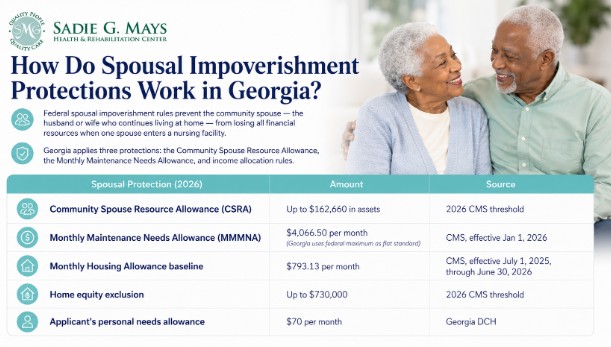
Federal spousal impoverishment rules prevent the community spouse — the husband or wife who continues living at home — from losing all financial resources when one spouse enters a nursing facility.
Georgia applies three protections: the Community Spouse Resource Allowance, the Monthly Maintenance Needs Allowance, and income allocation rules.
| Spousal Protection (2026) | Amount | Source |
| Community Spouse Resource Allowance (CSRA) | Up to $162,660 in assets | 2026 CMS threshold |
| Monthly Maintenance Needs Allowance (MMMNA) | $4,066.50 per month (Georgia uses federal maximum as flat standard) | CMS, effective Jan 1, 2026 |
| Monthly Housing Allowance baseline | $793.13 per month | CMS, effective July 1, 2025, through June 30, 2026 |
| Home equity exclusion | Up to $730,000 | 2026 CMS threshold |
| Applicant’s personal needs allowance | $70 per month | Georgia DCH |
The CSRA allows the community spouse to retain up to $162,660 of the couple’s combined countable assets in 2026, separate from and in addition to the $2,000 the applicant spouse may keep. Georgia calculates all assets of a married couple as jointly owned, regardless of whose name appears on the account.
Georgia uses $4,066.50 per month as its standard Monthly Maintenance Needs Allowance — meaning the community spouse is automatically entitled to receive income from the applicant spouse to bring total monthly income up to $4,066.50.
Community spouses whose shelter costs (rent, mortgage, property tax, homeowner’s insurance, and a state-specific utility allowance) exceed $793.13 per month may receive additional income above the $4,066.50 standard, subject to the same federal maximum set by CMS.
Families with complex asset profiles — retirement accounts in both names, jointly held real estate, or business interests — should consult a Georgia elder law attorney before filing the Medicaid application to ensure the CSRA calculation maximizes the community spouse’s protected assets.
Georgia enforces a 60-month (5-year) look-back period for all Nursing Home Medicaid and Medicaid waiver applications, per federal Medicaid rules administered by the Georgia Department of Community Health.
The look-back period begins on the date of the Medicaid application and extends 60 months backward. Georgia Medicaid reviews every financial transaction made by the applicant and the applicant’s spouse during those 60 months to identify assets that were gifted, sold below fair market value, or otherwise transferred without adequate compensation.
Any transfer of assets for less than fair market value during the look-back window triggers a penalty period of Medicaid ineligibility.
Common triggers include gifting cash to children or grandchildren, adding a child’s name to a bank account or deed, selling a vehicle to a family member for $1, paying for a grandchild’s college tuition, and funding home improvements on a child’s property. The IRS annual gift tax exemption of $19,000 per recipient in 2026 does not apply to Medicaid rules — a $19,000 gift that is tax-exempt under federal law still violates the Georgia Medicaid look-back period.
Georgia calculates the penalty period by dividing the total value of all disqualifying transfers by the state penalty divisor.
The Georgia penalty divisor is $11,122 per month, effective April 1, 2026, per the Georgia Department of Community Health memo dated March 31, 2026.
A family that gifted $100,000 within the look-back window faces approximately 9 months of Medicaid ineligibility ($100,000 ÷ $11,122 = 8.99 months). During those 9 months, the resident or family must pay the full private-pay nursing facility rate — $8,821 to $11,000 per month in the Atlanta metro area in 2026.
| Transfer Amount | Penalty Months (2026 Georgia Divisor: $11,122) | Approximate Private-Pay Cost During Penalty |
| $25,000 | 2.2 months | $19,400–$24,200 |
| $50,000 | 4.5 months | $39,700–$49,500 |
| $100,000 | 9.0 months | $79,400–$99,000 |
| $200,000 | 18.0 months | $158,800–$198,000 |
The penalty period does not begin until the applicant is in a nursing facility, has applied for Medicaid, and meets all other eligibility requirements except for the transfer violation.
Families who made transfers years ago and now face a penalty should consult a Georgia elder law attorney about partial asset returns — Georgia may reduce the penalty in proportion to the assets returned to the applicant.
Georgia recognizes several federally mandated exemptions. Transfers to a spouse carry no penalty regardless of the amount. Transfers of the primary home to an adult child who served as the applicant’s caretaker for at least two years before the nursing home admission — and whose care delayed the admission — are exempt.
Transfers of the primary home to a sibling with an equity interest who lived in the home for at least one year before the applicant’s admission are also exempt. Transfers to or for the benefit of a blind or disabled child carry no penalty.
Georgia Medicaid applications for nursing home coverage are submitted through the county Division of Family and Children Services (DFCS) office where the applicant lives or will receive care.
Families can apply online through the Georgia Gateway portal or submit a paper application at the local DFCS office.
Fulton County DFCS processes the majority of applications for skilled nursing facilities in northwest Atlanta, including applications for residents at Sadie G. Mays.
Georgia DFCS requires the following documentation to process a Nursing Home Medicaid application: proof of identity (government-issued ID or birth certificate), proof of Georgia residency, Social Security card, proof of all income sources for the prior three months (Social Security award letter, pension statements, bank interest statements), five years of bank statements covering the full look-back period, five years of investment and retirement account statements, property deeds, vehicle titles, life insurance policies, burial trust documentation, and a physician’s certification of nursing facility level of care.
Incomplete applications are the single most common cause of processing delays in Georgia. Missing even one month of bank statements within the 60-month look-back window can result in a request for information that extends the timeline by 30 days or more.
Families should compile documentation for every financial account held by the applicant and spouse — including closed accounts — before filing.
Georgia DFCS typically processes Nursing Home Medicaid applications within 45 to 90 days of receiving a complete application, per Georgia Department of Community Health processing standards. Complex cases involving asset transfers, trusts, or multiple income sources may take longer.
Sadie G. Mays accepts Medicaid-pending admissions, meaning families can secure a bed and begin receiving care while the application is under review — the facility does not require final Medicaid approval before admission.
Georgia Medicaid may provide retroactive coverage for up to three months prior to the application date if the applicant met all eligibility requirements during that period.
Families who delayed the application while a parent was receiving care — whether due to the hospital discharge process or paperwork delays — should request retroactive eligibility review to recoup costs already paid during the qualifying period.
If you’re ready to get started, call us now!
Georgia Medicaid-approved nursing home residents pay their patient liability — nearly all of their monthly income minus the $70 personal needs allowance and applicable Medicare premium deductions — directly to the facility each month.
Medicaid covers the remaining balance of the facility’s daily rate at the Georgia DCH Medicaid reimbursement rate.
Married residents whose community spouse earns below $4,066.50 per month may divert a portion of their income to the community spouse as a Monthly Maintenance Needs Allowance before calculating patient liability.
Community spouses whose shelter costs exceed $793.13 per month may receive additional income diversion, subject to the federal maximum published by CMS.
Residents must report any changes in income, assets, or marital status to Georgia DFCS within 10 days.
Medicaid eligibility is subject to periodic redetermination — Georgia DFCS contacts the resident or responsible party to verify continued eligibility.
Failure to respond to a redetermination request results in termination of benefits and requires a new application and a new 60-month look-back review.
Georgia participates in the Medicaid Estate Recovery Program, which allows the state to recover long-term care costs paid on behalf of a deceased Medicaid recipient from the recipient’s estate.
Georgia does not pursue recovery against estates valued at less than $25,000 — a threshold that provides meaningful protection for modest estates.
Recovery is deferred while a surviving spouse, a minor child (under 21), or a dependent disabled child is living. An undue hardship waiver is available for heirs who can demonstrate that estate recovery would cause them to qualify for need-based public assistance.
Families should discuss estate recovery implications with a Georgia elder law attorney before transferring or spending down assets during the Medicaid planning process.
What is the income limit for Georgia Nursing Home Medicaid in 2026?
Georgia sets the 2026 Nursing Home Medicaid income limit at $2,982 per month for a single applicant, equal to 300% of the Federal Benefit Rate. Nearly all income counts, including Social Security, pensions, and IRA distributions. Applicants above the limit may qualify through a Qualified Income Trust.
How much can the community spouse keep in assets under Georgia Medicaid?
The community spouse may retain up to $162,660 in countable assets under the 2026 Community Spouse Resource Allowance, separate from the applicant’s $2,000 limit. The primary home, one vehicle, and personal belongings are excluded from the calculation entirely.
How far back does Georgia Medicaid look at financial transactions?
Georgia enforces a 60-month look-back period beginning on the date of the Medicaid application. Every asset transfer made by the applicant or spouse during those 60 months is reviewed. Transfers made before the look-back window incur no penalty, regardless of the amount.
What is the Georgia Medicaid penalty divisor for 2026?
Georgia’s penalty divisor is $11,122 per month, effective April 1, 2026, per the Georgia Department of Community Health. Dividing the total uncompensated transfer amount by $11,122 yields the number of months during which the applicant is ineligible for Medicaid coverage.
Does the IRS gift tax exemption protect Medicaid applicants from look-back penalties?
The IRS allows individuals to gift up to $19,000 per recipient in 2026 without filing a federal Gift Tax Return. Georgia Medicaid does not recognize this exemption and treats any transfer within the look-back period as a potential penalty trigger regardless of federal tax treatment.
Can a family member keep the home if a parent goes on Medicaid in Georgia?
Georgia excludes up to $730,000 in equity from the primary home from countable assets, provided the applicant intends to return home or a spouse, minor child, or dependent disabled child resides there. Transfer of the home to a caretaker child who lived in the home for two or more years before admission is also exempt.
What is a Qualified Income Trust, and how does it work in Georgia?
A Qualified Income Trust, also called a Miller Trust, is an irrevocable trust that redirects income above the $2,982 monthly limit so Georgia Medicaid does not count the excess toward eligibility. Georgia requires Medicaid to be named as the trust beneficiary upon the recipient’s death.
How long does a Georgia Medicaid nursing home application take?
Georgia DFCS processes Nursing Home Medicaid applications within 45 to 90 days of receiving a complete submission. Incomplete documentation — especially missing bank statements within the 60-month look-back window — is the most common cause of delays extending beyond 90 days.
Does Sadie G. Mays accept Medicaid-pending admissions?
Sadie G. Mays accepts residents whose Georgia Medicaid applications are pending review. Families can secure a bed and begin receiving skilled nursing care while the application is processed through the Fulton County DFCS office without waiting for final Medicaid approval.
What does Georgia Medicaid estate recovery mean for heirs?
Georgia may recover Medicaid long-term care costs from a deceased recipient’s estate, but it does not pursue estates valued below $25,000. Recovery is deferred while a surviving spouse, minor child, or dependent disabled child is living, and an undue hardship waiver is available.
Your family needs to file a Medicaid application, compile five years of financial records, and secure a nursing facility bed — all while your parent needs care now. The Sadie G. Mays admissions team coordinates Medicaid-pending placements and connects families with Georgia elder law referrals. Call 678-420-2946 to start today.