
Paying for Skilled Nursing Care in Atlanta: The Complete 2026 Guide
Originally published: June 2026 | Reviewed by Sadie Mays

Originally published: June 2026 | Reviewed by Sadie Mays

Skilled nursing care in Atlanta costs between $8,821 and $11,000 per month for private-pay residents in 2026, based on the Genworth 2024 Cost of Care Survey.
Medicare Part A covers the first 100 days of post-hospital skilled nursing at a qualifying facility — with zero copay for days 1 through 20 and a $217 daily coinsurance for days 21 through 100 — but does not pay for long-term custodial stays.
Georgia Medicaid covers long-term care for residents who meet the $2,982 monthly income and $2,000 asset thresholds (2026).
Sadie G. Mays Health & Rehabilitation Center is a 206-bed, 501(c)(3) nonprofit skilled nursing facility in northwest Atlanta, founded in 1947, accepting Medicare, Medicaid, and most major insurance plans.
The discharge planner just handed you a list of facilities and a 72-hour timeline — the Sadie G. Mays admissions team can confirm bed availability and verify your insurance within 24 hours. Call 678-420-2946.
A semi-private room in an Atlanta-area skilled nursing facility averages $8,821 to $9,900 per month in 2026, while a private room runs $9,500 to $11,000 per month, based on the Genworth 2024 Cost of Care Survey and Georgia Department of Community Health rate data.
These figures represent all-inclusive daily rates that cover room and board, 24-hour nursing supervision, and standard skilled nursing services.
Atlanta metro costs run above the statewide Georgia median of approximately $7,600 to $7,800 per month due to higher labor costs, real estate values, and demand concentration among facilities in Fulton, DeKalb, and Cobb counties.
Families comparing long-term care costs in Atlanta should request an itemized rate sheet from each facility — not a brochure estimate — to identify what ancillary charges (pharmacy, medical supplies, therapy copays) fall outside the daily rate.
| Cost Category | Semi-Private Room (Monthly) | Private Room (Monthly) |
| Georgia statewide median (2026) | $7,600–$7,800 | $8,500–$9,500 |
| Atlanta metro average (2026) | $8,821–$9,900 | $9,500–$11,000 |
| Short-term rehab (20-day Medicare stay) | $0 copay (Medicare Part A) | $0 copay (Medicare Part A) |
| Days 21–100 (2026 Medicare copay) | $217 per day | $217 per day |
| Long-term Medicaid rate (Georgia) | Set by Georgia DCH | Set by Georgia DCH |
Facility type also affects cost. For-profit chains operate on margins of 3–5%, returning the remainder to investors, while nonprofit facilities like Sadie G. Mays reinvest their surplus into direct care, staffing, and capital improvements.
That structural difference led to a $3.2 million renovation in 2025, covering dining rooms, resident rooms, lobby areas, and shower facilities — funded entirely by operating revenue and donor support, not private equity.
Medicare Part A pays for skilled nursing care after a qualifying 3-day inpatient hospital stay, covering up to 100 days per benefit period at a certified skilled nursing facility, per Medicare.gov guidelines.
The 3-day requirement counts only inpatient days — observation status hours do not qualify, a distinction that catches many Atlanta families off guard during discharge planning.
If you’re ready to get started, call us now!
Medicare pays 100% of approved skilled nursing costs for days 1 through 20 of each benefit period. Days 21 through 100 require a daily coinsurance payment of $217 in 2026, as published in the CMS Federal Register notice of November 2025.
A new benefit period begins after the resident has been out of a hospital or skilled nursing facility for 60 consecutive days.
Covered services during a Medicare-paid stay include registered-nurse supervision, physical therapy, occupational therapy, speech-language pathology, medications administered during the stay, medical social services, and dietary counseling.
Sadie G. Mays provides all six rehabilitation and clinical services under one roof with 24-hour RN coverage and a geriatric-certified Medical Director.
Medicare does not pay for custodial care — assistance with bathing, dressing, eating, and toileting — when that help is the only care a resident needs. Once a resident no longer requires daily skilled nursing or therapy, Medicare coverage ends regardless of whether 100 days have elapsed. Families should review their Explanation of Benefits statements closely during a stay to track remaining covered days.
Medicare also does not cover long-term room and board after the skilled need ends. Families who anticipate a transition from short-term rehab to long-term placement should begin Medicaid planning or explore private-pay options before day 20, not after coverage lapses.
Medicare Advantage plans (Part C) often require prior authorization before approving a skilled nursing transfer. Denials or delays from Advantage plans are the single most common reason families lose their preferred facility placement in metro Atlanta.
Families enrolled in a Medicare Advantage plan should ask the hospital discharge planner to submit the authorization request within 24 hours of the physician’s SNF order and request written confirmation of approval before transport.
Georgia Medicaid pays for long-term skilled nursing care with no day limit for residents who meet both financial and clinical eligibility requirements, administered through the Georgia Department of Community Health.
Unlike Medicare, Medicaid covers custodial care, making it the primary funding source for residents who need help with daily activities indefinitely.
Georgia sets institutional Medicaid eligibility at $2,982 per month in income (300% of the Federal Benefit Rate) and $2,000 in countable assets for the applicant in 2026, per the Georgia Department of Community Health’s published eligibility standards.
A community spouse — the husband or wife who continues living at home — may retain a Community Spouse Resource Allowance of up to $162,660 in assets (2026 CMS threshold) and a Monthly Maintenance Needs Allowance, both indexed annually by CMS.
Countable assets include bank accounts, investment accounts, and non-exempt property. Georgia excludes the primary home (up to $730,000 in equity, 2026 CMS threshold), one vehicle, personal belongings, and irrevocable burial trusts.
Families with assets above the threshold should consult a Georgia elder law attorney about Medicaid-compliant planning strategies — ideally 30 months or more before a potential placement, given Georgia’s 5-year lookback period on asset transfers.
Applications go through the local Division of Family and Children Services office in the county where the applicant lives or will receive care. Fulton County DFCS processes the majority of applications for northwest Atlanta facilities.
Processing takes 45–90 days in most cases, during which the facility may hold a bed under a pending Medicaid agreement.
Sadie G. Mays accepts Medicaid and assists families with the application process through its admissions and social services team. Families can begin the admissions conversation while the Medicaid application is in progress — bed availability does not require final Medicaid approval.
The VA Aid and Attendance pension benefit pays up to $2,424 per month for a veteran with no dependents who needs regular assistance with daily activities and resides in a nursing facility, per the 2026 VA published MAPR tables, effective December 1, 2025.
Surviving spouses of eligible veterans may receive up to $1,556 per month in 2026. These benefits supplement — but do not replace — Medicare or Medicaid and can significantly reduce the out-of-pocket gap for veterans in Georgia nursing facilities.
Eligibility requires at least 90 days of active military service, including at least one day during a wartime period, plus a clinical determination that the veteran requires regular aid and attendance.
The VA application process averages 6–12 months, so families should file early — ideally at the same time they begin evaluating long-term care facilities in Atlanta.
Your family is weighing Medicare days, Medicaid eligibility, and VA benefits simultaneously — the Sadie G. Mays admissions team navigates these overlapping programs daily. Call 678-420-2946 to walk through your specific coverage scenario.
Long-term care insurance policies pay a fixed daily or monthly benefit — typically $150 to $350 per day — once the policyholder meets the plan’s benefit trigger, which usually requires inability to perform two or more activities of daily living independently.
Policies purchased before 2010 often carry higher daily maximums and longer benefit periods than those sold in subsequent years due to industry-wide repricing.
Families should request three documents from the insurance carrier before admission: the current daily benefit amount, the remaining lifetime benefit pool, and the specific elimination period (the number of days the policyholder must pay out of pocket before benefits begin). Elimination periods under most long-term care insurance policies range from 30 to 90 days.
During the 30- to 90-day elimination period, Medicare may cover costs if the stay qualifies as post-acute rehabilitation, effectively bridging the gap at no cost to the family.
Atlanta families with hybrid life-insurance/long-term-care policies should confirm whether the nursing facility benefit differs from the home health benefit — many hybrid products cap facility stays at 50–70% of the total pool.
If you’re ready to get started, call us now!
Out-of-pocket exposure depends entirely on which combination of payers covers the stay. A 30-day post-hospital rehab stay under Medicare Part A costs $0 for the first 20 days and $2,170 for days 21–30 at the 2026 coinsurance rate of $217 per day.
A 12-month long-term stay paid entirely out of pocket runs $105,852–$132,000 in the Atlanta metro area, based on the rate ranges in Section 1 of this guide.
| Scenario | Estimated Annual Out-of-Pocket Cost (2026) |
| 20-day Medicare rehab stay | $0 |
| 100-day Medicare stay (with copay days 21–100) | $17,360 |
| Long-term Medicaid (approved) | Personal income contribution only (most of the monthly income minus $70 Georgia personal needs allowance) |
| Long-term private pay, semi-private | $105,852–$118,800 per year |
| Long-term private pay, private room | $114,000–$132,000 per year |
| VA Aid & Attendance supplement | Reduces the gap by up to $29,088 per year |
Families paying privately should ask whether the facility offers a rate lock, a financial hardship policy, or a Medicaid-pending admission agreement.
Nonprofit facilities are more likely to offer flexible arrangements because their governance structure prioritizes census stability and mission fulfillment over margin optimization.
Sadie G. Mays works with families across all payer types — including respite care stays and short-term placements during Medicaid processing windows.
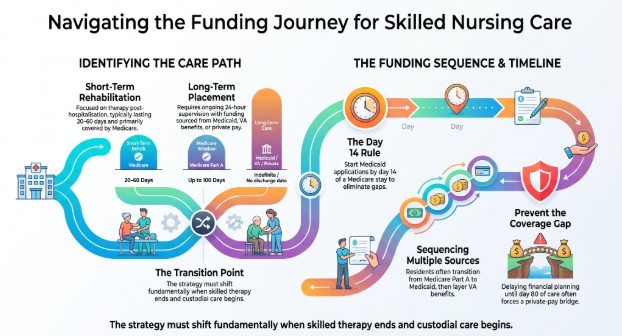
The right payment strategy matches the resident’s clinical trajectory — short-term rehabilitation versus long-term placement — to the family’s available funding sources, verified against actual eligibility rather than assumptions.
Short-term rehab residents enter after a hospital stay, receive daily physical, occupational, or speech therapy, and are discharged home within 20–60 days. Medicare covers most or all of this cost. Long-term residents need ongoing 24-hour nursing supervision with no discharge date — Medicaid, long-term care insurance, VA benefits, or private pay fund these stays.
The payment strategy changes fundamentally at the point where skilled therapy ends and custodial care begins.
Families who wait until day 80 of a Medicare stay to explore Medicaid or VA options face a coverage gap that forces either a private-pay bridge or a facility transfer. Starting the Medicaid application by day 14 of a Medicare stay eliminates that gap for most Georgia families.
Most long-term residents at Sadie G. Mays use two or more funding sources across the duration of their stay. A common Atlanta-area sequence runs: Medicare Part A (days 1–100 post-hospital) → Medicaid (once approved, retroactive to application date) → VA Aid and Attendance (supplementing the personal needs allowance).
Families with long-term care insurance layer that benefits on top of, or in place of, the private-pay period.
An elder law attorney or certified financial planner specializing in Medicaid can model the optimal sequencing of assets and income for a family’s specific profile.
The Sadie G. Mays social services team provides referrals to Georgia-based elder law attorneys and assists with coordination across payer transitions.
Does Medicare cover long-term nursing care in Atlanta?
Medicare Part A does not cover long-term custodial care. Medicare pays for skilled nursing stays up to 100 days per benefit period after a qualifying 3-day inpatient hospital stay, covering therapy and skilled services. Long-term coverage requires Georgia Medicaid, private pay, or long-term care insurance.
What is the daily copay for Medicare skilled nursing days 21 through 100?
CMS set the 2026 daily coinsurance at $217 for days 21 through 100 of a skilled nursing benefit period, up from $209.50 in 2025. Days 1 through 20 carry zero copay. After day 100, Medicare pays nothing, and the family assumes full financial responsibility.
How long does a Georgia Medicaid application take for nursing facility coverage?
Georgia Medicaid applications for institutional long-term care typically take 45 to 90 days to be processed by the county Division of Family and Children Services. Sadie G. Mays accepts Medicaid-pending admissions, meaning families can secure a bed while the application is under review.
What income limit qualifies someone for Georgia Medicaid nursing facility coverage?
Georgia sets 2026 institutional Medicaid eligibility at $2,982 per month in income, and $2,000 in countable assets, per Georgia Department of Community Health published standards. A community spouse may retain separate assets and income allowances under federal spousal impoverishment protections.
Can a veteran use Aid and Attendance benefits at a skilled nursing facility?
Veterans who served at least 90 days of active duty, including at least 1 day of wartime service, may qualify for VA Aid and Attendance, which can pay up to $2,424 monthly toward nursing facility costs in 2026. The social services team at Sadie G. Mays can connect families with accredited VA claims agents in the Atlanta area.
What happens if Medicare runs out before Medicaid is approved?
A coverage gap occurs when Medicare benefits are exhausted before Medicaid approval is complete. The resident or family becomes responsible for the daily private-pay rate during the gap. Filing the Medicaid application by day 14 of a Medicare stay minimizes this exposure for most Georgia families.
Does long-term care insurance work at a skilled nursing facility?
Long-term care insurance pays a daily or monthly benefit once the policyholder can no longer independently perform two or more activities of daily living. Benefit amounts range from $150 to $350 per day, and most policies impose a 30- to 90-day elimination period before payments begin.
How does a nonprofit skilled nursing facility differ from a for-profit facility in cost?
Nonprofit skilled nursing facilities reinvest operating surplus into resident care, staffing, and facility improvements rather than distributing profits to shareholders. Daily rates often match for-profit competitors, but revenue allocation — such as the $3.2 million facility renovation in 2025 — flows directly back into resident care.
What does the $2,000 Medicaid asset limit include in Georgia?
Georgia counts bank accounts, investment accounts, certificates of deposit, and non-exempt real property toward the $2,000 countable asset limit for 2026 institutional Medicaid. The state excludes the primary home up to $730,000 in equity, one vehicle, personal belongings, prepaid irrevocable burial trusts, and term life insurance with no cash value.
Is hospice care covered separately from skilled nursing?
Medicare Part A covers hospice as a separate benefit from skilled nursing, and residents can receive hospice services while in a nursing facility. Sadie G. Mays coordinates with Medicare-certified hospice agencies to deliver comfort-focused care, including room and board and nursing supervision, under the applicable payer.
Your parent needs a bed, your insurance situation is complicated, and the hospital wants an answer by Friday — the Sadie G. Mays admissions team untangles Medicare, Medicaid, and VA coverage questions every day. Call 678-420-2946 now to start the verification process.