
Long-Term Care Near Vine City & Northwest Atlanta: What Families Should Know
Originally published: October 2026 | Reviewed by Sadie Mays

Originally published: October 2026 | Reviewed by Sadie Mays

Long-term care near Vine City provides round-the-clock nursing and daily personal care for older adults who can no longer live safely at home, close enough for Westside families to stay involved.
Sadie G. Mays Health & Rehabilitation Center is a 206-bed nonprofit skilled nursing facility at 1821 Anderson Ave NW, in the same 30314 ZIP code as Vine City.
The center has offered long-term care to Atlanta’s older adults since 1947, and families can tour, review its inspection record, and settle payment before admission.
Choosing care for a parent is hard to do alone. The Sadie G. Mays admissions team at 678-420-2946 walks families through each next step.
Sadie G. Mays sits at 1821 Anderson Ave NW in northwest Atlanta, inside the same 30314 ZIP code that covers Vine City. A parent who moves from Vine City to the center stays on the city’s Westside, near the neighborhoods and medical providers the family already uses.
Vine City lies just west of downtown, with Mercedes-Benz Stadium at its eastern edge and the Atlanta University Center to the south. Distance matters most in the first weeks after a move, when frequent visits help a new resident settle in and let family catch changes early.
Families comparing nearby facilities can review transit, hospital, and neighborhood details for the whole 30314 ZIP code before narrowing a list.
Vine City carries its own civil rights history. Dr. Martin Luther King Jr. and Coretta Scott King bought the house at 234 Sunset Avenue in 1965, and the National Park Service brought the King Family Home into the Martin Luther King, Jr. National Historical Park in 2018.
Sadie G. Mays opened as Happy Haven on March 24, 1947, under a nonprofit led by Sadie Gray Mays, wife of Morehouse College president Dr. Benjamin E. Mays. In 1968, the home took in the last residents of the Fulton County Alms House, and the center’s history records its 1972 expansion to 206 beds.
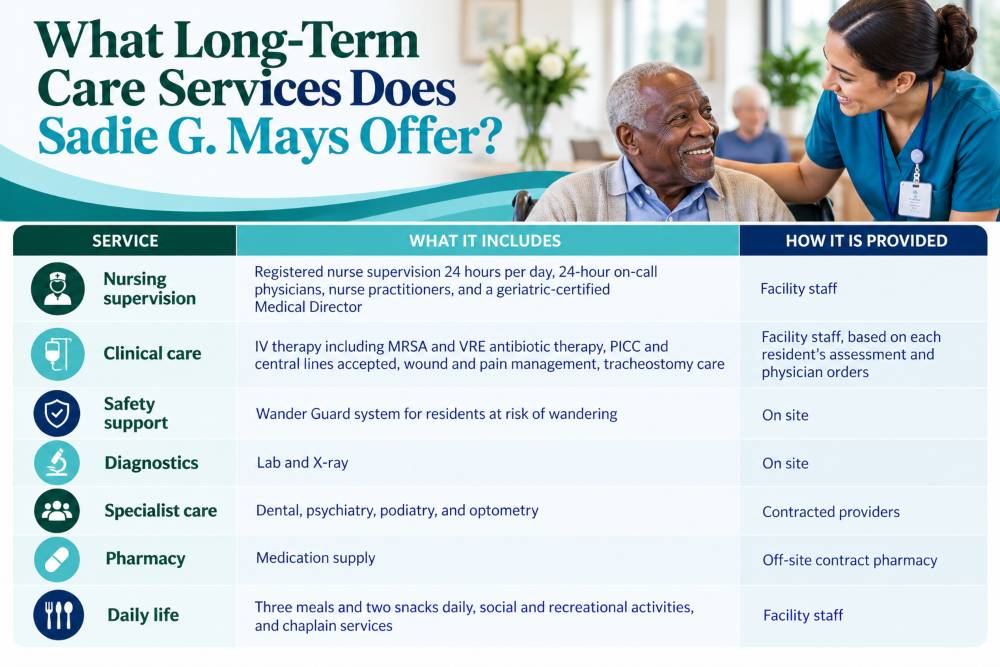
Sadie G. Mays provides long-term skilled nursing with nursing supervision, physician access, and clinical, diagnostic, and daily-life services, some delivered by staff and some by contracted providers.
| Service | What It Includes | How It Is Provided |
| Nursing supervision | Registered nurse supervision 24 hours per day, 24-hour on-call physicians, nurse practitioners, and a geriatric-certified Medical Director | Facility staff |
| Clinical care | IV therapy including MRSA and VRE antibiotic therapy, PICC and central lines accepted, wound and pain management, tracheostomy care | Facility staff, based on each resident’s assessment and physician orders |
| Safety support | Wander Guard system for residents at risk of wandering | On site |
| Diagnostics | Lab and X-ray | On site |
| Specialist care | Dental, psychiatry, podiatry, and optometry | Contracted providers |
| Pharmacy | Medication supply | Off-site contract pharmacy |
| Daily life | Three meals and two snacks daily, social and recreational activities, and chaplain services | Facility staff |
The $3.2 million renovation completed in 2025 remodeled the dining room, lobby, shower rooms, and resident rooms, and families can preview the building on the virtual tour.
Sadie G. Mays lists its location as served by MARTA bus and rail lines, and families coming from Vine City should map the full route, including any transfer and the final walk to the entrance, before the first visit.
Vine City station serves the Blue and Green rail lines, and MARTA bus Route 94 stops there, though large stadium events can shift that route temporarily to Ashby station. The station offers limited daily parking, and a pedestrian bridge over Northside Drive links it to Mercedes-Benz Stadium.
MARTA’s trip planner shows the current route from a Vine City address or the station to 1821 Anderson Ave NW, including any bus transfers and walking distance.
For visitors who use a wheelchair or walker, families can confirm the accessible route with MARTA and the accessible entrance with the admissions office before traveling.
Families who drive will find ample lighted parking on site, one of the center’s listed facility amenities, along with landscaped grounds and a secured courtyard.
If you’re ready to get started, call us now!
Three free public resources help Westside families compare options, check facilities, and resolve problems: Empowerline, the Georgia Long-Term Care Ombudsman Program, and CMS Care Compare.
| Resource | What It Does | How to Reach It |
| Empowerline | The Atlanta Regional Commission’s free information and referral service for older adults, people with disabilities, and caregivers across the 10-county Atlanta region | 404-463-3333 |
| Georgia Long-Term Care Ombudsman Program | Advocates for residents of long-term care facilities and works to resolve their concerns, with community ombudsmen in each county | 866-552-4464 |
| CMS Care Compare | Posts inspection results, staffing data, and quality measures for certified nursing homes | Online at Medicare.gov |
The Georgia Long-Term Care Ombudsman Program lets families find the community ombudsman for Fulton County. CMS Care Compare shows each certified facility’s latest inspection findings and staffing data.
A parent’s needs can outgrow home care quickly. Schedule a tour of Sadie G. Mays with the admissions team at 678-420-2946 to see long-term care.
Medicare does not pay for long-term custodial care, so families usually rely on Georgia Medicaid, long-term care insurance, or private funds for an extended nursing home stay. The payer depends on which kind of care the parent needs.
| Care Type | What It Is | Typical Length | Usual Payer |
| Long-term care | Ongoing nursing and daily personal care for needs that continue indefinitely | Open-ended, often a year or more | Georgia Medicaid, long-term care insurance, or private funds |
| Short-term rehabilitation | Therapy and skilled nursing toward a set recovery goal and discharge date | Weeks to a few months | Original Medicare Part A when its rules are met, or a Medicare Advantage plan |
| Respite care | A short planned stay that gives a family caregiver a break | Short, scheduled ahead | Depends on the arrangement: private pay, or the hospice benefit’s inpatient respite level when hospice applies; admissions confirms any other coverage |
Under Original Medicare, skilled nursing coverage is conditional: it generally follows a qualifying inpatient hospital stay of at least 3 days and continues only while the resident needs daily skilled care.
Part A covers at most 100 days per benefit period, and coverage can stop well before day 100 once daily skilled care is no longer needed.
Accountable Care Organization waivers and Medicare Advantage plans can set different rules, and Medicare’s long-term care page confirms that custodial care alone is not covered.
Georgia’s 2026 Medicaid financial limits set a $2,982 monthly income cap and a $2,000 resource limit for an individual in a nursing home, and applicants must also need a nursing facility level of care.
Separate rules apply to married couples, and a person whose income is above the cap may still qualify through a Qualified Income Trust, so families confirm eligibility with Georgia’s Division of Family and Children Services.
Georgia Medicaid also requires PASRR screening before admission to a Medicaid-certified nursing facility.
Sadie G. Mays accepts Medicare, Medicaid, VA contract, managed care, private pay, and other insurance.
Accepting a payer does not settle a person’s eligibility or guarantee a bed, since the state decides Medicaid eligibility, admissions confirms availability, and the Georgia Medicaid application includes a five-year look-back at asset transfers.
A first call to admissions covers the parent’s care needs, payer, and timeline, and admission follows once the center confirms it can meet those needs and the paperwork is complete. Families shorten that process by having four items ready.
The admissions team can evaluate a prospective resident on site at a hospital, an assisted living facility, or a private home, and the center admits residents seven days a week.
Pre-admission paperwork includes a DMA-6 physician’s recommendation, medical history and physical exam notes, a Level I screening, and rehabilitation notes when applicable, as set out in the center’s admissions requirements.
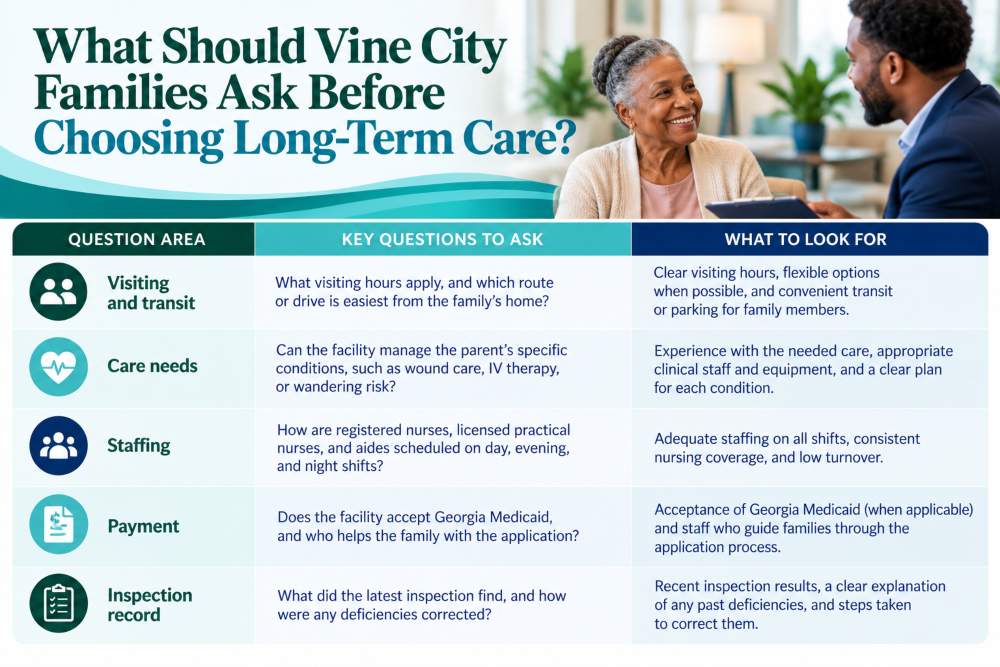
Families get the clearest picture by asking about visiting logistics, care for specific conditions, payment, and each facility’s inspection record.
Bringing these questions on a tour, alongside other nursing home tour questions on staffing and safety, gives families a fair basis for comparing facilities.
What should families have ready before calling admissions?
Families should have a short summary of the parent’s diagnoses, medications, and daily care needs, plus insurance and Medicare or Medicaid details. When a hospital stay is involved, the discharge planner’s contact information and expected discharge date help admissions plan.
What is the difference between long-term care and short-term rehab?
Long-term care is ongoing nursing and personal care for needs that continue indefinitely, usually paid by Georgia Medicaid or private funds. Short-term rehab targets a set recovery goal and discharge date, often after a hospital stay, and Original Medicare Part A may cover it.
Does Medicare pay for long-term care in a nursing home?
No. Medicare does not pay for long-term custodial care, the daily help with bathing, dressing, and other personal tasks. Original Medicare Part A covers short-term skilled nursing only while daily skilled care is needed, up to 100 days per benefit period.
How do families pay for long-term care in Georgia?
Georgia families usually pay through Georgia Medicaid, long-term care insurance, or their own funds. Georgia’s 2026 nursing home Medicaid limits are $2,982 in monthly income and $2,000 in resources for an individual, with special rules for married couples and higher incomes.
What does Empowerline do?
Empowerline is the Atlanta Regional Commission’s free information and referral service for older adults, people with disabilities, and caregivers across the 10-county metro Atlanta region. Counselors help families sort through care options and local services by phone at 404-463-3333 or online.
What does a long-term care ombudsman do in Georgia?
A Georgia long-term care ombudsman advocates for nursing home residents and works to resolve complaints about resident rights, quality of care, and discharges. Ombudsmen also visit facilities to talk with residents. The program’s number is 866-552-4464, and every Georgia nursing home posts local contact details.
How long has Sadie G. Mays served Atlanta?
Sadie G. Mays has served Atlanta since March 24, 1947, when it opened as Happy Haven with room for up to 60 residents. The home took its founder’s name in 1972, expanded to 206 beds that year, and adopted its current name in 1997.
Does Sadie G. Mays offer short stays for family caregivers?
Sadie G. Mays offers respite care, a short planned stay that gives a family caregiver time to rest, travel, or handle other obligations while the older adult receives round-the-clock care. Families arrange respite stays through the admissions team at 678-420-2946.
Sadie G. Mays gives Vine City families a nonprofit long-term care option in the same 30314 ZIP code, reachable by car or by a MARTA trip planned in advance.
Medicare doesn’t cover long-term custodial care, so payment usually comes from Georgia Medicaid, long-term care insurance, or private funds.
Empowerline and the Georgia Long-Term Care Ombudsman Program offer free help before and after admission.
Keeping a parent close to the Westside community matters. Contact the Sadie G. Mays admissions team at 678-420-2946 to plan a visit.