
What Happens When Rehabilitation Ends but a Resident Still Needs Support? The Role of Restorative Nursing
Originally published: August 2026 | Reviewed by Sadie Mays

Originally published: August 2026 | Reviewed by Sadie Mays
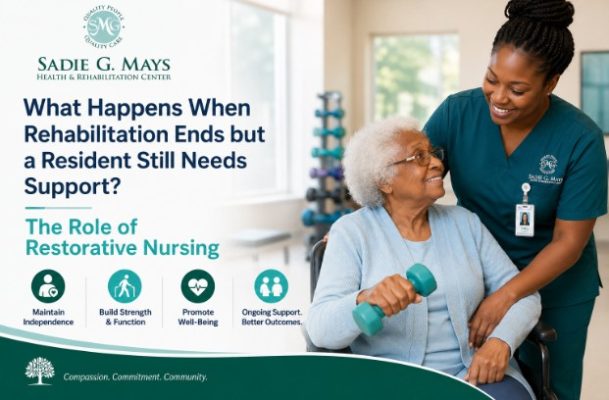
Restorative nursing begins when a resident’s formal physical, occupational, or speech therapy program ends, but the resident still needs support to maintain daily function.
Sadie G. Mays Health & Rehabilitation Center is a 206-bed, 501(c)(3) nonprofit skilled nursing facility in northwest Atlanta, founded in 1947, and its restorative nursing services continue where rehab therapy leaves off.
Nursing assistants trained in restorative techniques continue mobility, dressing, and eating exercises daily, so residents keep the gains rehab produced instead of losing them over time.
Watching a parent lose rehab gains is exhausting — the Sadie G. Mays admissions team explains how restorative nursing helps keep those gains in place.
Restorative nursing is the nursing-led program that continues after formal physical, occupational, or speech therapy discharges a resident from rehab. The Centers for Medicare & Medicaid Services, in the Long-Term Care Facility Resident Assessment Instrument 3.0 User’s Manual, defines a restorative nursing program as nursing interventions that promote a resident’s ability to adapt and adjust to living as independently and safely as possible.
Nursing assistants trained in restorative techniques carry the skills a resident’s short-term rehabilitation team taught — walking, transferring, dressing, eating — into daily routine, so the resident does not lose function once formal therapy stops.
Restorative nursing is not rehab therapy itself; it is the nursing-model bridge that keeps therapy gains from eroding, as defined in CMS’s Resident Assessment Instrument Manual (version 1.20.1, effective October 1, 2025). Relias
The handoff generally happens once a resident’s physical, occupational, or speech therapist discharges them from formal therapy.
Restorative nursing programs generally begin when a resident is discharged from formal physical, occupational, or speech rehabilitation therapy, though a program can also start when restorative needs arise during a longer-term stay.
How that handoff happens varies by facility—some build restorative goals directly from the therapy discharge summary, while others require a separate nursing assessment first.
Families in discharge planning should ask their care team whether a restorative nursing referral is part of the transition plan, since the handoff isn’t automatic everywhere. Minnesota Department of Health
If you’re ready to get started, call us now!
A restorative nursing program covers a defined set of daily activities, not general supervision. Programs typically include:
Each activity should tie to a specific goal set during the resident’s care plan meeting, so progress — or decline — gets documented rather than assumed.
A registered nurse designs and periodically evaluates restorative nursing programs documented under CMS’s Minimum Data Set framework.
Restorative Nursing programs must include measurable objectives for the activity, documented interventions, and periodic evaluation by a registered nurse, with staff trained in the specific interventions they implement.
This documentation requirement distinguishes a formal restorative nursing program from informal assistance — a nursing assistant helping a resident walk to lunch is not the same as a documented, RN-evaluated restorative program.
A strong handoff typically carries specific functional goals from the therapy team directly into nursing’s restorative plan at discharge, giving nursing staff clinical detail to work from rather than a general instruction to keep the resident active. Minnesota Department of Health
Coordinating restorative nursing and Medicare rules raises a lot of questions — Sadie G. Mays’ admissions staff work through them with families.
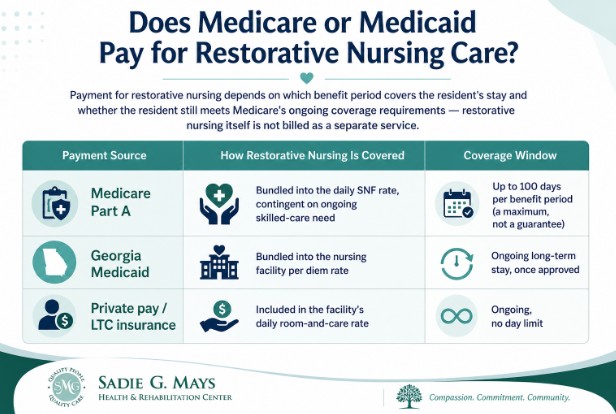
Payment for restorative nursing depends on which benefit period covers the resident’s stay and whether the resident still meets Medicare’s ongoing coverage requirements — restorative nursing itself is not billed as a separate service.
| Payment Source | How Restorative Nursing Is Covered | Coverage Window |
| Medicare Part A | Bundled into the daily SNF rate, contingent on ongoing skilled-care need | Up to 100 days per benefit period (a maximum, not a guarantee) |
| Georgia Medicaid | Bundled into the nursing facility per diem rate | Ongoing long-term stay, once approved |
| Private pay / LTC insurance | Included in the facility’s daily room-and-care rate | Ongoing, no day limit |
Medicare Part A covers days 1 through 20 of a skilled nursing facility stay at no cost to the resident, requires a $217 daily coinsurance for days 21 through 100, and Part A limits SNF coverage to 100 days in each benefit period.
That 100-day figure is a ceiling, not an entitlement — coverage continues only as long as the resident still needs daily skilled care, and it can end earlier if that clinical need ends.
Once a resident moves past day 100 or transitions to long-term custodial care, restorative nursing continues as part of the facility’s daily rate, covered through Georgia Medicaid’s long-term services and supports program for residents who qualify financially, or through private-pay arrangements.
Families exploring Georgia Medicaid nursing home eligibility should confirm restorative nursing is included in the facility’s daily rate before assuming a separate bill will arrive. Medicare
If you’re ready to get started, call us now!
Restorative nursing and skilled rehab therapy share a goal — preserving function — but differ in who provides the care, how it’s billed, and how Medicare classifies it.
Therapy is based on the medical model and moves faster toward significant progress in a fairly short time, while restorative nursing programs are based on the nursing model and focus on maintaining function in a long-term, ongoing process.
That distinction describes who delivers the care and at what pace — it does not mean Medicare only pays for therapy when a resident is expected to improve. Under the Jimmo Settlement Agreement, Medicare covers skilled therapy when a qualified therapist’s specialized judgment and skills are necessary for a safe and effective maintenance program, whether the goal is improvement, maintaining current function, or slowing decline.
A resident can therefore remain on Medicare-covered skilled therapy for maintenance reasons; restorative nursing becomes the option once a licensed therapist’s specific skills are no longer required and a trained nursing assistant can safely continue the activity. Ltcpu
| Feature | Skilled Rehab Therapy | Restorative Nursing |
| Provided by | Licensed PT, OT, or speech therapist | Trained nursing assistant, RN-supervised |
| Medicare basis | Skilled therapist judgment needed, for improvement or maintenance (Jimmo Settlement standard) | Bundled into daily nursing rate once therapist-level skill is no longer required |
| Pace | Intensive, typically time-limited | Ongoing, daily |
| Billing | Separate Medicare therapy minutes | Bundled into daily nursing rate |
A resident comparing skilled nursing versus short-term rehab options should understand that restorative nursing typically follows formal therapy once a licensed therapist’s specific skills are no longer required — not simply once progress plateaus.
Functional decline can happen after a rehab discharge if no restorative plan replaces the structured therapy schedule, though how quickly that happens varies by resident and condition.
Families reviewing the first days after a rehab transition should watch for a resident needing more help with a task they were doing independently at discharge, increased fatigue during previously manageable activities, or a nursing assistant reporting skipped restorative sessions on the daily record.
Before formal therapy ends, families can ask the care team directly:
Any of the warning signs above warrants a direct question to the care plan team about whether the restorative program needs adjustment, or whether the resident needs a broader look at long-term care options.
What is restorative nursing?
Restorative nursing is a nursing-led program that maintains a resident’s physical, mental, and psychosocial function after formal rehab therapy ends. Trained nursing assistants, supervised by a registered nurse, continue mobility, self-care, and communication exercises daily so the resident does not lose the skills rehab therapy restored.
When does restorative nursing start after rehab ends?
Restorative nursing generally begins once a resident’s physical, occupational, or speech therapy team discharges them from formal therapy. The nursing team reviews the therapy discharge summary and builds restorative goals from the skills the resident practiced, though exact timing varies by facility and resident.
Who provides restorative nursing care?
Trained nursing assistants, sometimes called restorative aides, provide the daily hands-on restorative activities. A registered nurse designs each resident’s program, sets measurable goals, documents progress, and periodically evaluates whether the plan still fits the resident’s current condition.
Does Medicare pay for restorative nursing?
Medicare Part A bundles restorative nursing into the daily skilled nursing facility rate, but only while the resident continues to meet Medicare’s skilled-care requirements. The 100-day period is a maximum, not a guarantee; days 21–100 require $217 daily coinsurance in 2026.
Does Medicare guarantee 100 days of skilled nursing facility coverage?
No. Medicare Part A allows up to 100 days per benefit period, but coverage continues only as long as the resident still needs daily skilled nursing or therapy care. If that clinical need ends sooner, Medicare coverage stops before day 100.
Does Georgia Medicaid pay for restorative nursing?
Georgia Medicaid bundles restorative nursing into the nursing facility’s daily per diem rate for residents who qualify financially and meet the nursing facility’s level-of-care requirements. Coverage continues for the length of the long-term stay once Medicaid approval is in place.
How is restorative nursing different from physical therapy?
A licensed therapist delivers physical therapy, and under Medicare’s Jimmo Settlement standard, it can be covered to improve or maintain function. Restorative nursing is delivered by trained nursing assistants under RN supervision and continues daily maintenance activities once formal therapy is no longer clinically needed.
How long does a restorative nursing program last?
Restorative nursing has no fixed end date; it continues as long as a resident needs support maintaining daily function. A registered nurse reevaluates the program periodically and adjusts or discontinues specific interventions as the resident’s needs change.
Can a resident return to formal rehab after starting restorative nursing?
Yes. If a restorative nursing evaluation shows a resident could regain additional function, or still requires a licensed therapist’s specific skills, the nursing team can refer the resident back to physical, occupational, or speech therapy for a new course of formal rehab.
How often is a restorative nursing care plan reviewed?
CMS requires a registered nurse to periodically evaluate documented restorative nursing programs. Beyond that requirement, the resident’s broader care plan is reviewed on the facility’s standard schedule, with additional reviews triggered whenever a family member or staff notices a change in function.
What happens if restorative nursing isn’t enough to maintain a resident’s function?
If restorative nursing cannot maintain a resident’s current function, the interdisciplinary team reassesses whether the resident needs renewed formal therapy, a higher level of nursing support, or a broader conversation with the family about long-term care planning.
Restorative nursing typically begins after formal rehab therapy ends, using trained nursing assistants under RN supervision instead of licensed therapists.
Medicare Part A and Georgia Medicaid both bundle it into the daily facility rate rather than billing it separately, and Medicare’s 100-day SNF benefit is a maximum tied to ongoing skilled-care need, not a guarantee.
Under the Jimmo Settlement standard, Medicare-covered therapy itself can also be a maintenance program — the choice between therapy and restorative nursing depends on whether a licensed therapist’s specific skills are still required, not just on whether the resident is still improving.
A parent’s independence after rehab shouldn’t depend on hope — the Sadie G. Mays admissions team turns that into a clear daily care plan. Call 678-420-2946.