
How Hospice and Nursing Home Care Work Together: What Families Should Expect When Comfort Becomes the Goal
Originally published: August 2026 | Reviewed by Sadie Mays

Originally published: August 2026 | Reviewed by Sadie Mays
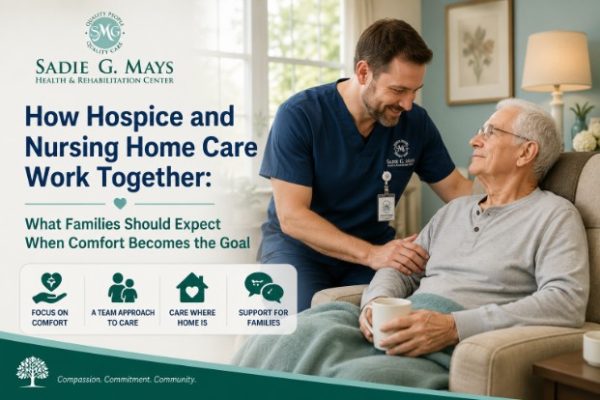
When a Sadie G. Mays resident elects hospice, the hospice team and the nursing facility team share responsibility for the resident’s care rather than one replacing the other.
Sadie G. Mays Health & Rehabilitation Center is a 206-bed, 501(c)(3) nonprofit skilled nursing facility in northwest Atlanta, founded in 1947, and its nursing staff continues providing daily custodial care — room, board, personal care, meals — while the hospice interdisciplinary team manages pain relief, comfort medications, and support specific to the terminal diagnosis.
Federal regulation requires the hospice to build its plan of care in consultation with the nursing facility, naming which provider handles which function.
Deciding on hospice is one of the hardest calls a family makes — the Sadie G. Mays admissions team explains how the two teams coordinate.
Electing hospice does not mean transferring out of the nursing facility or losing the facility’s care team — for most residents, hospice becomes an added layer of support delivered on top of existing nursing home care.
Hospice care is a comprehensive set of services identified and coordinated by an interdisciplinary group to address the physical, psychosocial, spiritual, and emotional needs of a terminally ill resident and family, laid out in a specific plan of care.
A physician must certify that the resident has a terminal prognosis of six months or less if the illness runs its normal course, and the resident (or resident representative) must formally elect the hospice benefit—hospice is a choice, not an automatic transfer of the resident’s care.
Electing hospice while remaining a nursing facility resident is common: hospice care can be delivered in the resident’s existing room, coordinated with the facility rather than replacing it.
If you’re ready to get started, call us now!
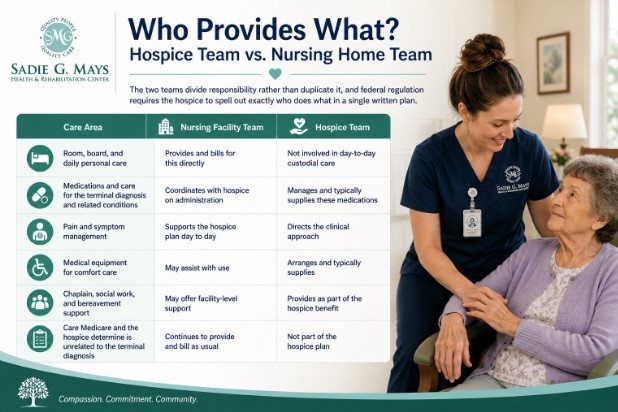
The two teams divide responsibility rather than duplicate it, and federal regulation requires the hospice to spell out exactly who does what in a single written plan.
| Care Area | Nursing Facility Team | Hospice Team |
| Room, board, and daily personal care | Provides and bills for this directly | Not involved in day-to-day custodial care |
| Medications and care for the terminal diagnosis and related conditions | Coordinates with hospice on administration | Manages and typically supplies these medications |
| Pain and symptom management | Supports the hospice plan day to day | Directs the clinical approach |
| Medical equipment for comfort care | May assist with use | Arranges and typically supplies |
| Chaplain, social work, and bereavement support | May offer facility-level support | Provides as part of the hospice benefit |
| Care Medicare and the hospice determine is unrelated to the terminal diagnosis | Continues to provide and bill as usual | Not part of the hospice plan |
Federal regulation requires a written hospice plan of care, established and maintained in consultation with the nursing facility, that identifies which provider is responsible for each agreed-upon function.
Whether a given condition counts as “unrelated” to the terminal diagnosis is a clinical determination the hospice makes and documents — Medicare services for a condition completely unrelated to the terminal condition for which hospice was elected remain available to the resident — but the determination depends on the individual resident’s clinical picture, not a fixed list of conditions that are always in or out. eCFR
If you’re ready to get started, call us now!
Federal regulation requires the hospice to designate a member of its interdisciplinary group to coordinate the resident’s hospice care with nursing facility staff and to communicate with the facility’s medical director, the resident’s attending physician, and other treating physicians.
In practice, this means the resident’s attending physician doesn’t have to change—the hospice’s interdisciplinary group prepares its own plan of care in consultation with the patient’s attending physician, so the same doctor can continue overseeing care alongside the hospice team rather than being replaced by it.
Hospice staff and nursing facility staff also share training: hospice orients facility staff on comfort-focused care, pain control, and symptom management specific to the resident’s diagnosis, so the nursing staff already caring for the resident understands the hospice approach rather than learning it secondhand.
Hospice care runs on the hospice’s own written plan of care, not a replacement for the nursing facility’s existing care-planning obligations.
The hospice plan of care must reflect the participation of the hospice, the nursing facility, and the resident and family to the extent possible, and any changes to it must be discussed with the resident or representative and facility staff before being implemented.
The facility’s own comprehensive care plan continues to exist and is coordinated with the hospice plan, rather than one document standing in for both.
Electing hospice is a natural checkpoint for reviewing whether the resident’s existing care plan still reflects their current condition — similar in spirit to the significant-change review process that applies whenever a resident’s condition shifts substantially — but hospice election on its own does not automatically require a full significant-change assessment; whether one is needed still depends on whether the resident’s actual condition meets the significant-change criteria at that point.
Medicare does not cover room and board for hospice care delivered in a nursing home; a resident may have to pay for room and board out of pocket if Medicare hospice is the only coverage in place.
Georgia Medicaid can close that gap for residents who qualify: under the federal Medicaid hospice payment rule, Medicaid reimburses the hospice provider a nursing facility room-and-board rate equal to at least 95% of the Medicaid skilled nursing facility rate, and the hospice is responsible for passing that payment through to the nursing facility.
| Payer | What It Typically Covers |
| Medicare hospice benefit | Hospice visits, medications for the terminal diagnosis, medical equipment, and interdisciplinary support — not room and board |
| Georgia Medicaid | Can cover both the hospice benefit and nursing facility room and board for residents who qualify financially |
| Private pay / long-term care insurance | Fills the room-and-board gap when Medicare alone is the payer |
Georgia’s Department of Community Health administers hospice reimbursement using the facility’s own Medicaid per diem rate as the basis for that pass-through, alongside the state’s broader Medicaid long-term care coverage.
Families paying for skilled nursing care should ask directly whether their specific payer combination covers both pieces before assuming either one does.
Hospice covers care related to the terminal diagnosis and related conditions — it does not cover every medical need a resident has.
Whether a specific illness or symptom counts as related is a clinical judgment the hospice team documents, based on the resident’s overall condition rather than a general rule about that type of diagnosis; a urinary tract infection or a fall isn’t automatically unrelated for every resident, since a condition can sometimes be connected to or complicated by the terminal illness.
Families sometimes assume hospice means all medical care stops except comfort measures, when in fact conditions determined to be unrelated are still actively treated through the nursing facility’s regular medical care.
Families weighing hospice against continuing restorative nursing or other maintenance-focused care should ask both teams directly which specific services shift to hospice and which stay with the facility for their resident’s situation.
The shift to hospice involves a defined set of steps, not an abrupt handoff:
Does hospice replace nursing home care?
No. The nursing facility continues providing room, board, and daily personal care, while the hospice team manages pain relief, symptom control, and support related to the terminal diagnosis. The two coordinate their care rather than one replacing the other.
Who provides medical care once a resident is on hospice?
The hospice team manages care specifically related to the terminal diagnosis and related conditions, including medications, pain control, and equipment. The nursing facility continues handling daily custodial care and any medical needs the hospice determines are unrelated to the terminal illness.
Does the resident have to leave the nursing facility to receive hospice?
No. Hospice care can be delivered in the resident’s existing room at the nursing facility. The resident typically stays in the same facility and maintains the same daily routine, with the hospice team coordinating with the facility rather than relocating the resident.
Who pays for hospice care in a nursing home?
Medicare’s hospice benefit covers hospice services — visits, medications for the terminal diagnosis, and equipment — but not room and board. Georgia Medicaid can cover both the hospice benefit and nursing facility room and board for residents who meet the financial eligibility requirements.
Does electing hospice automatically trigger a new care plan review?
Not automatically. Hospice election is a natural checkpoint for the facility to check whether the resident’s care plan still reflects their current status. A full Significant Change in Status Assessment is required only if the resident’s actual condition meets that criteria, not from election alone.
Can a resident’s own doctor still be involved after electing hospice?
Yes. The hospice’s plan of care is developed in consultation with the resident’s attending physician, who can continue overseeing care alongside the hospice medical director. For the initial certification period, federal rules require both physicians to certify the terminal prognosis if the resident has an attending physician.
What happens to care for conditions determined to be unrelated to the terminal diagnosis?
Conditions the hospice documents as unrelated to the terminal diagnosis continue through the nursing facility’s regular medical care, not the hospice benefit. Relatedness is a clinical judgment made case by case, not an automatic classification based on the type of condition.
How is it decided whether a resident’s care is related to the terminal illness?
The hospice team makes that determination clinically, considering the resident’s overall diagnoses and condition rather than applying a fixed list. Medicare requires coverage for conditions the hospice documents as genuinely unrelated to the terminal illness and related conditions.
Can a resident stop hospice care and go back to regular treatment?
Yes. A resident or representative can revoke the hospice election at any time and resume standard medical treatment, including treatment aimed at curing or managing the terminal condition. The nursing facility continues providing care throughout, regardless of the hospice decision.
Who decides whether a resident is eligible for hospice?
Eligibility isn’t a facility decision alone. For the initial certification period, federal rules require certification by the hospice medical director (or a physician member of the hospice team) and, if the resident has one, the attending physician; later recertifications require only the hospice physician.
Hospice adds a layer of comfort-focused care on top of the nursing facility’s existing role, not in place of it.
The facility keeps providing room, board, and daily personal care; the hospice team manages the terminal diagnosis and related conditions; and federal regulation requires the two to coordinate their respective plans of care rather than operate independently.
Medicare covers the hospice services themselves, while Georgia Medicaid can close the room-and-board gap for qualifying residents, and whether a specific condition falls inside or outside the hospice benefit is a clinical judgment made for that resident, not a fixed rule.
Weighing hospice doesn’t mean starting over with a new care team — the Sadie G. Mays admissions team explains how it works. Call 678-420-2946.